
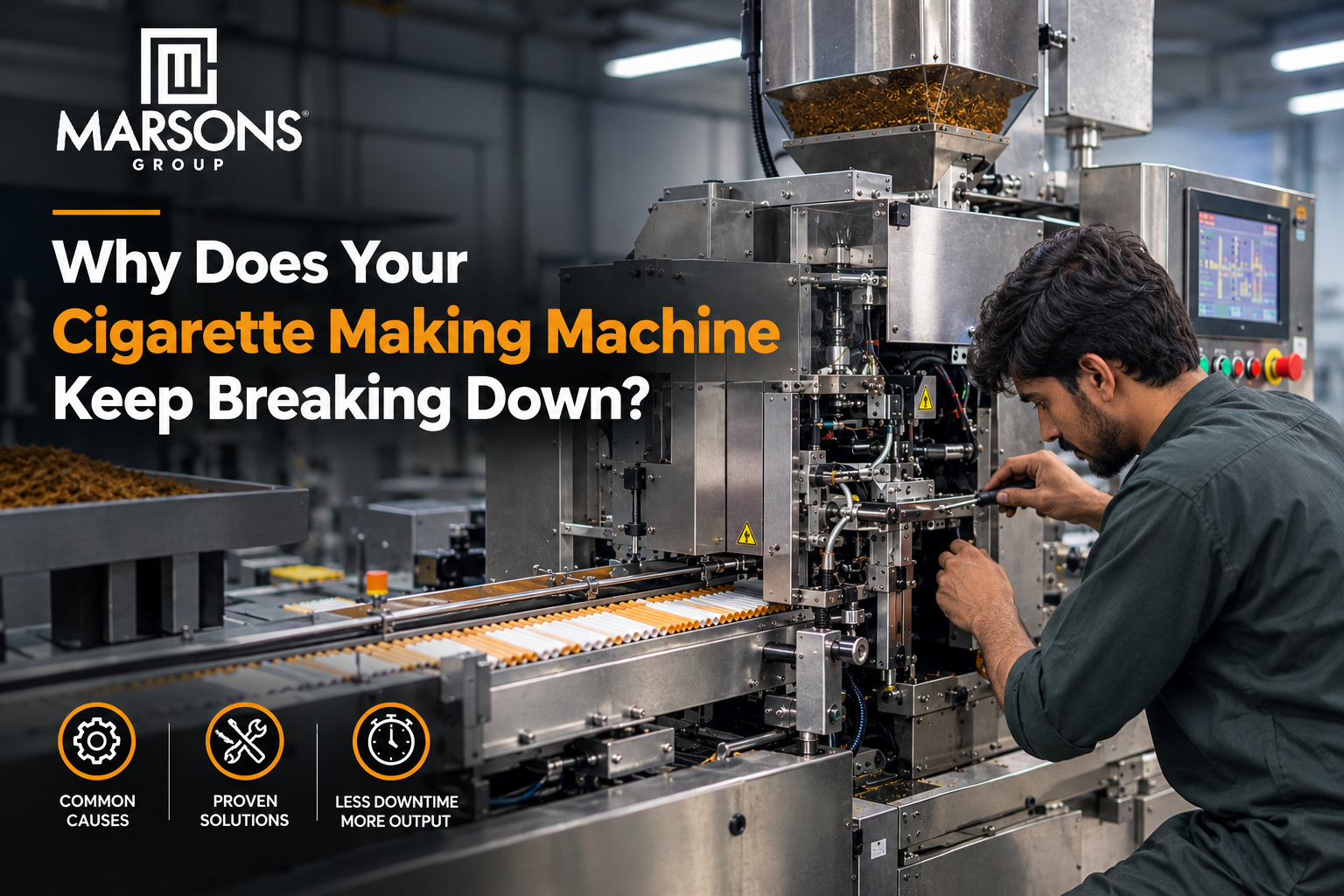
A cigarette making machine that keeps stopping can become a serious problem for any tobacco factory. One day, production runs smoothly. The next, operators are dealing with repeated interruptions, maintenance teams are checking the same components, and production targets start slipping. When repairs only provide temporary relief, it may be time to assess the equipment more closely. Manufacturers facing these challenges can explore the Cigarette Making Machines offered by Marsons Group to evaluate machinery options that better suit their production requirements.
The frustrating part is that recurring breakdowns rarely have a single obvious explanation. Worn components, inconsistent tobacco feeding, poor cleaning practices, and electrical faults can all interrupt production. Understanding the most common cigarette making machine downtime causes helps manufacturers identify what is going wrong and, more importantly, why the same problems keep returning.
What Are the Most Common Cigarette Making Machine Downtime Causes?
When a cigarette making machine breaks down, the fault is not always where it first appears. A problem in the feeding system, for example, may affect cigarette formation. Similarly, a mechanical component that has moved slightly out of alignment can interfere with several other parts of the machine. Most recurring failures involve mechanical wear, material handling problems, electrical faults, or maintenance issues.
Mechanical Wear and Component Failure
Cigarette making machines contain numerous moving components that operate under continuous mechanical stress. Bearings, rollers, cutting blades, belts, and garniture tapes gradually wear during normal operation.
A worn component does not always cause an immediate breakdown. Sometimes the machine continues working while producing unusual vibrations, inconsistent cuts, or feeding difficulties. These symptoms can easily go unnoticed during a busy production shift.
If the problem continues, the affected component may place additional strain on surrounding assemblies. Regular inspections and timely replacement of worn parts can prevent a relatively minor fault from developing into a more expensive repair.
Tobacco Dust Buildup and Poor Machine Cleaning
Tobacco dust is a normal part of cigarette manufacturing, but allowing it to accumulate around machinery can create avoidable problems.
Fine particles may collect near suction channels, sensors, and moving components. Adhesive residue can also build up around cigarette paper handling mechanisms. Over time, these deposits may interfere with normal machine operation or make existing mechanical problems worse.
Cleaning should therefore be part of routine equipment maintenance rather than something performed only after production problems appear. Appropriate cleaning methods are essential, particularly because combustible dust requires careful handling.
Inconsistent Tobacco Feeding and Material Quality
A cigarette making machine depends on a steady supply of tobacco through its feeding system. When that flow becomes irregular, production can suffer even if the machine’s mechanical components are functioning correctly.
Differences in tobacco moisture, particle size, or preparation can contribute to inconsistent feeding and material blockages. Cigarette paper quality and alignment may cause similar interruptions.
Before making extensive mechanical adjustments, operators should check whether these problems coincide with changes in raw materials. Sometimes the solution lies in material preparation rather than the machine itself.
Electrical Faults and Sensor Malfunctions
Electrical faults are another common reason for unexpected stoppages. Modern cigarette making machines rely on sensors, motors, electrical connections, and control systems to coordinate production.
A damaged cable or unreliable sensor may cause intermittent faults that are difficult to identify during routine inspection. The machine might restart successfully, only to stop again several hours later.
Rather than repeatedly resetting the system, qualified maintenance technicians should investigate the relevant alarms, electrical connections, and control components. This makes it easier to address the actual fault instead of temporarily clearing its symptoms.
How Does Poor Maintenance Lead to Repeated Machine Breakdowns?
One reason cigarette making machines develop recurring problems is that small maintenance issues are often left unresolved for too long.
A bearing may begin making noise, a belt may require adjustment, or a cutting component may gradually lose accuracy. None of these issues necessarily stops production immediately. As a result, maintenance may be postponed until the machine develops a more serious fault.
This approach can become expensive. A component that could have been adjusted or replaced during planned maintenance may eventually damage other parts of the machine.
A practical maintenance schedule should cover lubrication, cleaning, alignment checks, and inspection of components subject to regular wear. Keeping records of completed repairs is equally important. If the same part fails repeatedly, maintenance teams need to investigate why rather than continue replacing it.
Why Do Cigarette Production Lines Experience Unplanned Stoppages?
A factory does not need a major machine failure to lose valuable production time. Several short interruptions during a shift can have a considerable effect on total output.
An unplanned stoppage on a cigarette line might begin with something relatively minor, such as a paper jam, temporary feeding interruption, or incorrectly positioned sensor. Although production may resume quickly, the same problem can return if its cause is not addressed.
Cigarette making equipment also operates as part of a larger production process. A disruption in tobacco supply or downstream product handling may force the main machine to stop even when it has no mechanical fault.
For this reason, troubleshooting should involve examining the entire sequence of events. Knowing which part of the line stopped first can prevent unnecessary repairs and help technicians focus their investigation.
How Can You Identify the Root Cause of Frequent Machine Failures?
Suppose a machine repeatedly damages the same bearing. Replacing that bearing may get production running again, but what happens if it fails a few weeks later?
At that point, the bearing itself may not be the real problem. Incorrect alignment, poor lubrication, or unusual operating loads could be contributing to the repeated damage.
This is why root cause analysis matters.
Maintenance teams should begin by reviewing what happened before the failure. Was there unusual vibration? Did the problem appear after a change in operating speed? Have similar faults occurred during previous shifts?
Operator observations, maintenance records, and machine alarm histories can help answer these questions. Once the likely cause has been identified, technicians should verify it through appropriate inspection and testing.
The purpose is not simply to get the equipment running again. It is to understand why it stopped and prevent the same problem from recurring.
How Does Machine Downtime Affect OEE in Cigarette Manufacturing?
Production managers often measure downtime by the number of minutes or hours a machine remains stopped. While that information is useful, it does not tell the whole story.
Overall Equipment Effectiveness, or OEE, offers a broader way to assess manufacturing performance. Tracking OEE in cigarette manufacturing helps managers evaluate three important factors: availability, performance, and quality.
Availability reflects how much planned production time the equipment actually spends operating. Performance measures whether the machine runs at its expected production rate. Quality looks at how much of the output meets the required standards.
A machine might experience very few major breakdowns but still lose production through frequent brief stoppages, reduced operating speed, or rejected products.
Separating these losses helps manufacturers understand whether maintenance, operating practices, or quality problems deserve greater attention.
What Can Tobacco Factories Do to Reduce Machine Downtime?
Factories trying to reduce machine downtime in a tobacco factory should begin by looking at the problems that occur most frequently.
There is little benefit in introducing complicated maintenance procedures if basic inspections are being missed or recurring faults are not recorded properly.
Start with regular checks of mechanical components, feeding mechanisms, and electrical systems. Ensure cleaning procedures are followed consistently and that commonly required spare parts are available when needed.
Operators should also be encouraged to report changes in machine behavior. Someone who works with the equipment every day may notice unusual sounds, vibration, or feeding irregularities well before a serious failure occurs.
Maintenance teams can then compare these observations with stoppage records to identify patterns.
The most effective improvements are often practical ones: addressing worn components promptly, correcting repeated adjustment problems, and ensuring that previously identified faults are not ignored once production resumes.
When Should You Repair or Replace Your Cigarette Making Machine?
A machine that breaks down frequently is not necessarily ready for replacement. In some cases, the problem may be limited to worn components or assemblies that can be repaired or rebuilt.
However, there comes a point when repeated repairs deserve a closer financial assessment.
If maintenance expenses continue increasing, replacement parts become difficult to obtain, or the equipment cannot maintain the required production performance, manufacturers should reconsider whether continued repairs are economical.
It helps to examine the machine’s service history rather than focusing only on the latest breakdown. How often does it stop? Which components fail repeatedly? How much production time is being lost during maintenance?
These questions provide a clearer picture of whether repairing, rebuilding, or replacing the equipment makes practical sense.
A technical assessment can help manufacturers reach a decision based on equipment condition and expected operating requirements.
How Can the Right Cigarette Machine Manufacturer Improve Equipment Reliability?
The equipment supplier can influence how easily a factory maintains and repairs its machinery over time.
Production capacity and machine specifications are important, but they should not be the only considerations during equipment selection. Buyers also need to understand the availability of spare parts, technical documentation, maintenance assistance, and support for the equipment they are purchasing.
This is especially relevant when considering rebuilt cigarette making machines. The condition of the equipment, the refurbishment work completed, and the availability of suitable replacement components should be evaluated carefully.
If you are planning to purchase machinery or compare suppliers, read the Cigarette Machine Manufacturer Guide for Modern Tobacco Production to understand which factors deserve attention before making an investment.
Marsons Group supplies new and rebuilt tobacco machinery, spare parts, and technical assistance. These services are worth considering when assessing equipment options and ongoing maintenance requirements.
Final Thoughts:
When a cigarette making machine keeps breaking down, the quickest repair is not always the best solution. Replacing a damaged part may restore production, but if the underlying problem remains, another stoppage may not be far away.
Mechanical wear, inconsistent feeding, electrical faults, and inadequate maintenance can all affect equipment reliability. The important thing is to recognize patterns instead of treating every breakdown as an isolated event.
Regular inspections, accurate maintenance records, and proper fault investigation make it easier to understand what is happening inside the machine. They also help manufacturers decide when a repair is worthwhile and when more extensive equipment improvements should be considered.
Ultimately, reducing recurring breakdowns comes down to identifying problems early, making the right corrections, and maintaining equipment according to its operating requirements.