Few capital decisions shape a tobacco manufacturing business as permanently as the choice between semi automatic and fully automatic equipment. The global cigarette making equipment market was valued at $15.8 billion in 2024 and is projected to reach $26.3 billion by 2034, and much of that growth is being driven by manufacturers upgrading their automation level rather than simply adding capacity. Yet the correct answer is not automatically the faster machine. Buyers evaluating Cigarette Making Machines for the first time often anchor on output specifications and overlook the variables that actually determine profitability: consistent demand, available labour, format variety and the technical depth of the maintenance team. This guide walks through the real trade offs so you can match the machine class to your operation rather than to an aspiration.
What Actually Separates the Two Machine Classes
The distinction is not simply speed. It is how many decisions the machine makes without an operator present.
How a Semi Automatic Line Runs
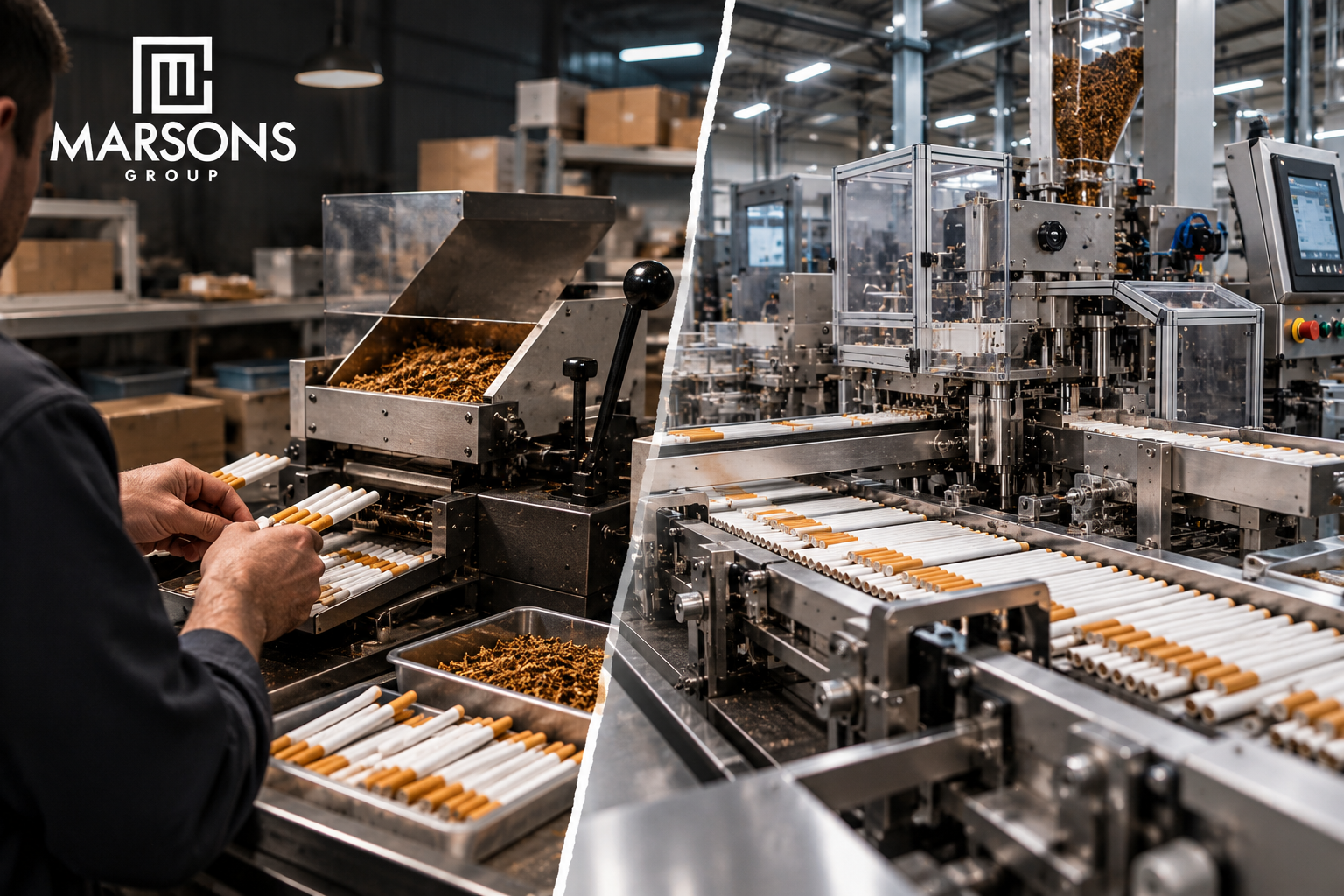
On a semi automatic line, the machine performs the mechanical work of rod forming, filter attachment and cutting, while operators handle feeding, transfers between stages, quality sampling and frequently the packing stage as well. Semi automated equipment is generally specified in the 500 to 3,000 cigarettes per minute band, with lighter roll your own class machinery operating between 50 and 200 per minute. The result is a flexible line that can be reconfigured quickly for small batches, custom blends or niche orders, but one whose output rises and falls with the skill and attention of the people running it.
What Full Automation Changes
A fully automatic maker integrates rod forming, filter attachment, inspection, rejection and transfer into a continuous sequence governed by the control system. Weight control systems measure rod density segment by segment, often across 24 segments of a single rod, and automatically reject units that fall outside the programmed tolerance. Operators shift from production work to supervision and exception handling.
Output Capacity Is the First Filter
Be honest about demand rather than installed capacity, because an underutilised fast machine loses money every shift.
Under 500 Cigarettes Per Minute
Local brands, contract fillers and businesses serving limited distribution territories rarely saturate anything faster. An entry level cigarette machine in this bracket keeps capital exposure low while you prove demand.
500 to 3,000 Cigarettes Per Minute
This is the natural home of the semi automatic class and the segment favoured by small and medium scale manufacturers in emerging markets for its affordability and flexibility. It suits regional brands running multiple SKUs with moderate volumes per SKU.
5,000 Per Minute and Above
Established industrial machines sit here, with mid speed makers running around 5,500 cpm on PLC control and newer variants reaching 8,000 to 8,500 cpm with touchscreen interfaces and built in inspection. At the top end, suppliers offer solutions processing up to 20,000 cigarettes per minute, and typical maker packer systems in large plants run 8,000 to 12,000 sticks per minute.
Understanding Fully Automatic Cigarette Machine Price Brackets
The fully automatic cigarette machine price question rarely has a single answer, because the quoted figure is only part of the commitment. Price scales with rated speed, inspection sophistication, control architecture and the number of format kits included. A machine with integrated density scanning, automatic rejection and electronic size change tooling costs substantially more than a mechanically similar unit without them. Then come the costs buyers underestimate: foundation and installation, electrical and compressed air infrastructure, commissioning, operator training, an initial spare parts holding and the import and clearance charges relevant to your market. A useful discipline is to request a quotation that separates the base machine from format parts, inspection modules and the commissioning package, so you can see which line items are genuinely optional and which the supplier has simply bundled.
Labour Economics Decide More Than Speed Does
Semi automatic lines convert capital cost into recurring labour cost. That trade is attractive where wages are moderate and skilled operators are available, and punishing where labour is scarce, expensive or inconsistent. Calculate your cost per thousand sticks under both scenarios across three shifts, including supervision, rework and the waste generated by human variability. Then test the result against demand volatility. A semi automatic line can be throttled down during slow months by simply scheduling fewer shifts, whereas a fully automatic line carries its depreciation regardless of whether it runs. For businesses with seasonal or uncertain order books, that flexibility has real financial value that speed comparisons never capture.
Consistency, Waste and the Hidden Tobacco Saving
Quality control is where full automation quietly pays for itself. The parameters that matter are diameter, weight, pressure drop and ends stability, and weight variation causes overfilling, underfilling, loose ends, broken cigarettes and wasted material. Automated weight control also delivers an advantage most buyers never calculate: tight density control allows a maker to run at a lower mean filling weight while still keeping units above the minimum threshold, which saves tobacco on every single stick produced. Across millions of units, that saving compounds into a meaningful line on the cost sheet. Semi automatic lines can achieve good consistency through disciplined sampling and skilled operators, but the discipline must be maintained manually, every shift, indefinitely.
Format Flexibility and Changeover Time
If you run one SKU, changeover barely matters. If you run six, it may matter more than speed. Modern makers have made real progress here: current flexible platforms complete a quick size change format conversion in around two hours, and some systems use preset back up groups, simplified fixation and a guided wizard with optical code scanning so size changes often require no tools at all, which nearly eliminates operator error. Older designs demand removing individual format parts from the machine frame, a time consuming process that can consume an entire shift. Before purchase, ask specifically how many hours a length change and a diameter change each take on the exact model quoted, and how many format kits are included.
Maintenance Capability and Supplier Support
A fully automatic machine without a competent maintenance function becomes an expensive stationary object. Plants running structured, cycle count based preventive maintenance on maker packer lines see unplanned downtime fall by more than 40% within twelve months, with OEE above 94% achievable. That outcome depends on parts availability, documentation and trained technicians rather than on the machine alone. This is where supplier selection carries as much weight as machine selection, and a practical Cigarette Machine Manufacturer Guide for Modern Tobacco Production is worth reviewing before shortlisting vendors. Established suppliers such as Marsons Group are typically evaluated on parts lead times, local technical presence and training provision rather than on headline speed figures alone.
Choosing an Entry Level Machine Without Capping Your Growth
A small scale cigarette machine should not become a ceiling eighteen months after installation. Protect yourself by checking three things: whether format parts for additional sizes can be purchased later, whether the control system can accept inspection or weight control modules as an upgrade, and whether the supplier offers a defined migration path to higher speed equipment. Newer machine generations increasingly emphasise standardised components and backward compatibility with existing spare parts inventories, which lowers the cost of stepping up later. Buying a platform that can grow is usually cheaper than buying a cheaper machine twice.
A Practical Decision Framework
Buy semi automatic if your demand sits below roughly 3,000 cigarettes per minute, you run several SKUs in modest volumes, skilled labour is available at reasonable cost, your order book is seasonal, or you are still validating market demand. Buy fully automatic if you consistently run a full shift at capacity, labour is expensive or difficult to retain, your buyers demand tight dimensional tolerances, or regulatory and contractual requirements make automated inspection and rejection necessary.
Final Conclusion
Neither class is objectively superior. The semi automatic segment holds 45% of the market precisely because it fits a large and growing set of manufacturers extremely well. Decide by mapping your realistic twelve month demand, your true labour cost per thousand sticks, your SKU count and your maintenance capability. Then insist on a quotation that separates base price from options, and confirm changeover times and parts support in writing before you commit.