If you’re scaling a cannabis or hemp business, one of the first big equipment decisions you’ll face is whether to invest in a purpose-built pre roll machine or attempt to repurpose a traditional tobacco cigarette machine. On the surface, the two look similar: both fill a paper tube with plant material and produce a finished, ready-to-smoke product. But the materials, regulatory requirements, and production goals behind cannabis and tobacco couldn’t be more different, and that difference shapes which machine actually belongs on your production floor.
This guide breaks down the real distinctions between the two categories of equipment, what happens when businesses try to adapt tobacco machinery for cannabis, and how to choose the right investment for your production volume, budget, and growth plans. If you want a deeper technical look at how modern equipment operates before diving into the comparison, Cannabis Cigarette Machine: How It Works & Why You Need One walks through the automated filling, rolling, and sealing process in detail.
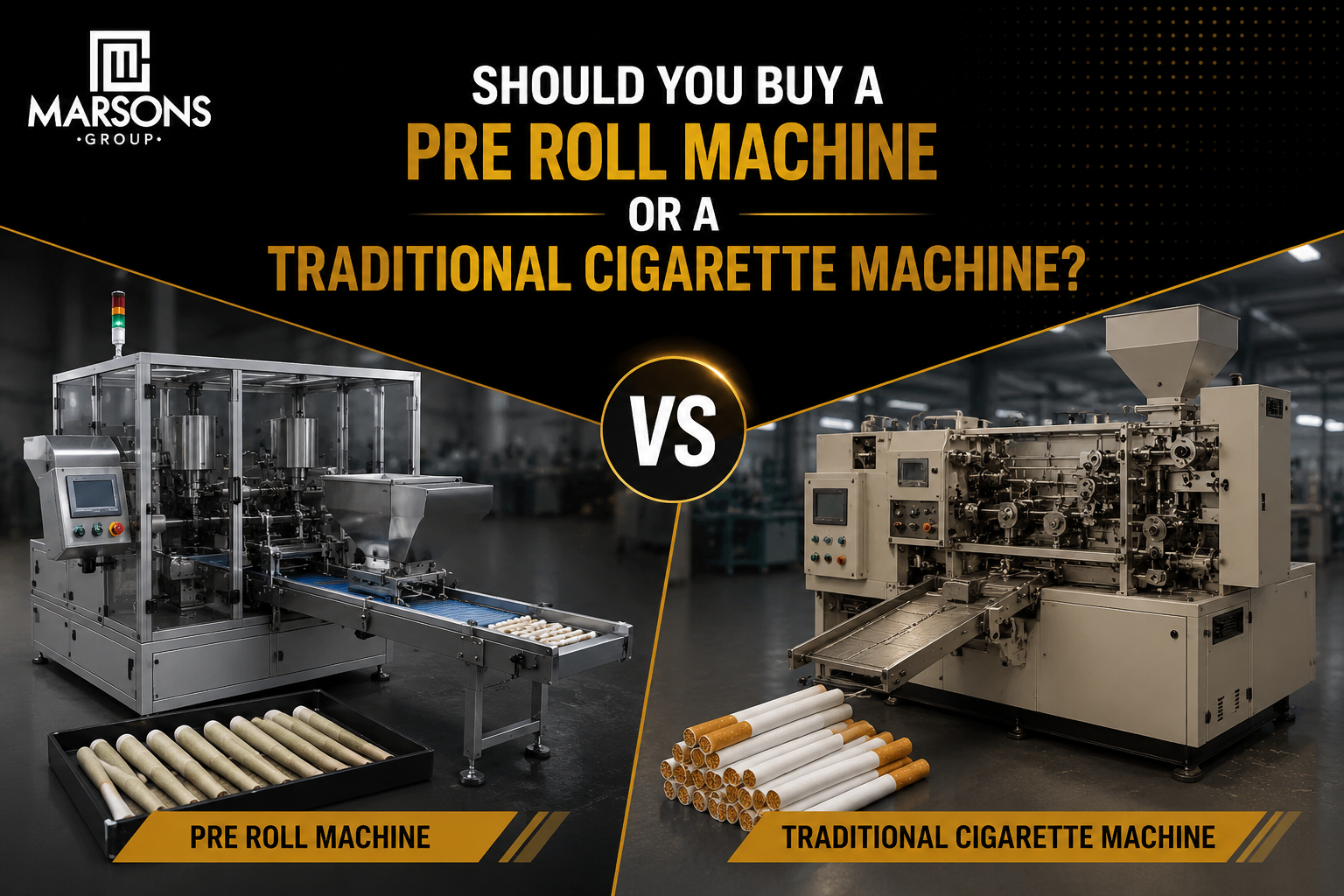
Understanding the Core Differences: Pre Roll Machines vs. Traditional Cigarette Machines
At a glance, both machines automate the same basic task: filling a tube with plant material and finishing it into a smokable product. But the engineering underneath tells a different story. Traditional cigarette machines were built around tobacco, a material that’s shredded into fine, uniform ribbons and flows predictably through hoppers, augers, and packing chambers. Cannabis behaves nothing like that.
What Makes Cannabis Pre-Roll Equipment Different
Cannabis flower is ground into irregular particles rather than shredded into ribbons, and it carries far more resin, moisture, and oil than cured tobacco. These cannabis pre-roll equipment differences show up immediately on a production line: cannabis clumps, sticks to metal surfaces, and packs unevenly if the machine wasn’t engineered to handle it. That’s why modern pre-roll machines use vibration-based filling systems, wider fill chambers, and specialized tamping mechanisms designed specifically to settle ground flower evenly into cones without crushing the trichomes that carry flavor and potency.
Why Traditional Cigarette Machines Struggle With Cannabis
Tobacco cigarette machines, including well-known industrial models, weren’t designed with cannabis’s physical properties in mind, and that mismatch creates real production problems.
The Challenges of Adapting Cigarette Machines for Cannabis
Adapting a cigarette machine for cannabis production sounds like a shortcut, but in practice it often creates more headaches than it solves. Cannabis’s sticky, resinous composition causes frequent clogging in machinery built for dry, shredded tobacco, which means more downtime and more manual intervention. These machines also demand extensive cleaning between runs, since leftover resin buildup affects both hygiene and the taste of the next batch. On top of that, industrial cigarette machines carry a high upfront cost and expensive maintenance contracts that were never designed around cannabis’s unique handling requirements, making the “adapt what you already have” approach less economical than it first appears.
Can You Adapt a Cigarette Machine for Cannabis Production?
Technically, yes. Some cannabis producers have modified tobacco equipment with new feed mechanisms, adjusted tamping pressure, and swapped components to accommodate cannabis flowers. But technical possibility isn’t the same as practical viability.
Modifications, Limitations, and Hidden Costs
Retrofitting a cigarette machine typically means replacing feed systems, adding anti-clog components, and running the machine at a fraction of its rated speed to avoid jamming. Even with these changes, output quality tends to be inconsistent, and packing density often varies from cone to cone, which creates compliance issues in markets that regulate pre-roll weight tolerances. Add in the labor cost of frequent cleaning cycles and the risk of unplanned downtime, and many operators find that the “savings” of reusing old equipment disappear within the first few months.
Key Features to Look for in Pre-Roll Production Equipment
Not all pre-roll production equipment is built the same, so it pays to know what separates a reliable machine from one that will bottleneck your operation. Look for stainless steel construction, which resists resin buildup and is easier to sanitize. Vibration or nitrogen-fluidization filling systems tend to pack cones more evenly than gravity-fed designs. Tool-free, removable parts speed up cleaning between batches, a critical factor given how often cannabis residue needs to be cleared. Scale accuracy also matters: machines that weigh to within 0.01g help you stay compliant with dosage regulations while minimizing product giveaway. Finally, consider whether the machine supports multiple cone sizes and infusion capability, since infused and multi-format pre-rolls are an increasingly large share of the market.
Cost Comparison: Investment, Output, and Long-Term ROI
Budget is often the deciding factor, and the price range across pre-roll equipment is wide. Entry-level and semi-automated fillers generally start around a few thousand dollars and suit small batches or early-stage production. Craft-scale automated fill-and-close lines typically fall in the tens of thousands, offering a strong middle ground for growing brands. Fully automated enterprise systems can exceed six figures but replace entire manual teams while producing thousands of consistent joints per hour.
Traditional cigarette machines adapted for cannabis rarely offer a cost advantage once you factor in modification expenses, slower throughput, and higher maintenance needs. Most operators report a return on investment for purpose-built pre-roll equipment within roughly six to eighteen months, depending on production volume and how much manual labor the machine displaces. When comparing options, look past the sticker price and calculate total cost of ownership, including installation, training, and annual maintenance, before committing.
Production Volume and Scalability: Which Wins for Growing Businesses?
If you’re producing a few hundred pre-rolls a week, a compact semi-automated filler may be all you need. But businesses planning to scale should think several steps ahead. Purpose-built pre-roll machines are engineered with cannabis throughput in mind, meaning they maintain consistent speed and fill quality even as daily output climbs into the thousands. Traditional cigarette machines, even when modified, tend to hit a performance ceiling much sooner, since the very adaptations that make them cannabis-compatible often slow them down. For businesses with growth plans, investing early in scalable, cannabis-specific equipment avoids the disruption and expense of replacing machinery later.
Product Quality and Consistency: Cones vs. Rolled Cigarettes
Consumer expectations for pre-rolls have risen sharply as the category has matured, and quality now plays a major role in repeat purchases. Pre-roll machines are designed to replicate the even, hand-rolled density consumers associate with premium joints, using radial compaction or vibration settling to avoid the loose or overpacked feel that turns customers away. Cigarette machines, by contrast, are optimized for tightly packed tobacco cylinders, a texture and burn profile that doesn’t translate well to cannabis flower. Inconsistent packing density can also create compliance risks in regulated markets, where dosage accuracy is legally required. For brands competing in a crowded, quality-driven pre-roll market, this consistency gap is one of the strongest arguments for dedicated equipment.
Industry Trends: Where the Pre-Roll Market Is Headed
The pre-roll category isn’t a niche corner of the cannabis industry anymore. It has become one of its largest and fastest-growing segments, with several recent industry reports showing pre-rolls overtaking flower as the top-selling product type by unit volume. Infused pre-rolls, which combine flower with concentrates for higher potency, now represent a substantial and growing share of pre-roll sales, and that trend shows no sign of slowing. As demand shifts toward more sophisticated, higher-margin products, the equipment gap between basic cigarette machinery and purpose-built pre-roll systems becomes even more pronounced. Infusion, precise dosing, and multi-format flexibility simply aren’t things adapted tobacco machines were built to handle.
Making the Right Choice for Your Business
There’s no single right answer for every operation. The best choice depends on your current volume, budget, growth trajectory, and product strategy. A small craft producer testing the market may get by with an entry-level filler, while a scaling brand chasing infused and multi-pack formats needs equipment engineered for that complexity from day one.
Questions to Ask Before You Buy
Before making a decision, ask yourself: How many pre-rolls do I need to produce daily, and how will that number change in twelve months? What’s my total budget, including maintenance and training, not just the purchase price? Do I need infusion capability now or in the near future? And how important is packing consistency to my brand’s quality reputation? If your business also touches hemp-derived biomass alongside cannabis, it’s worth exploring a reliable Hemp Cigarette Making Machine built to handle both material types, giving your production line more flexibility as your product mix evolves.
Conclusion
Traditional cigarette machines were never built with cannabis’s sticky, resinous, irregularly ground flower in mind, and adapting them almost always trades short-term savings for long-term maintenance headaches and inconsistent output. A dedicated pre roll machine, by contrast, is engineered from the ground up to handle cannabis’s unique properties, delivering better consistency, regulatory compliance, and scalability as your production needs grow. For most cannabis and hemp businesses serious about quality and long-term efficiency, purpose-built pre-roll production equipment isn’t just the safer choice. It’s the smarter one.