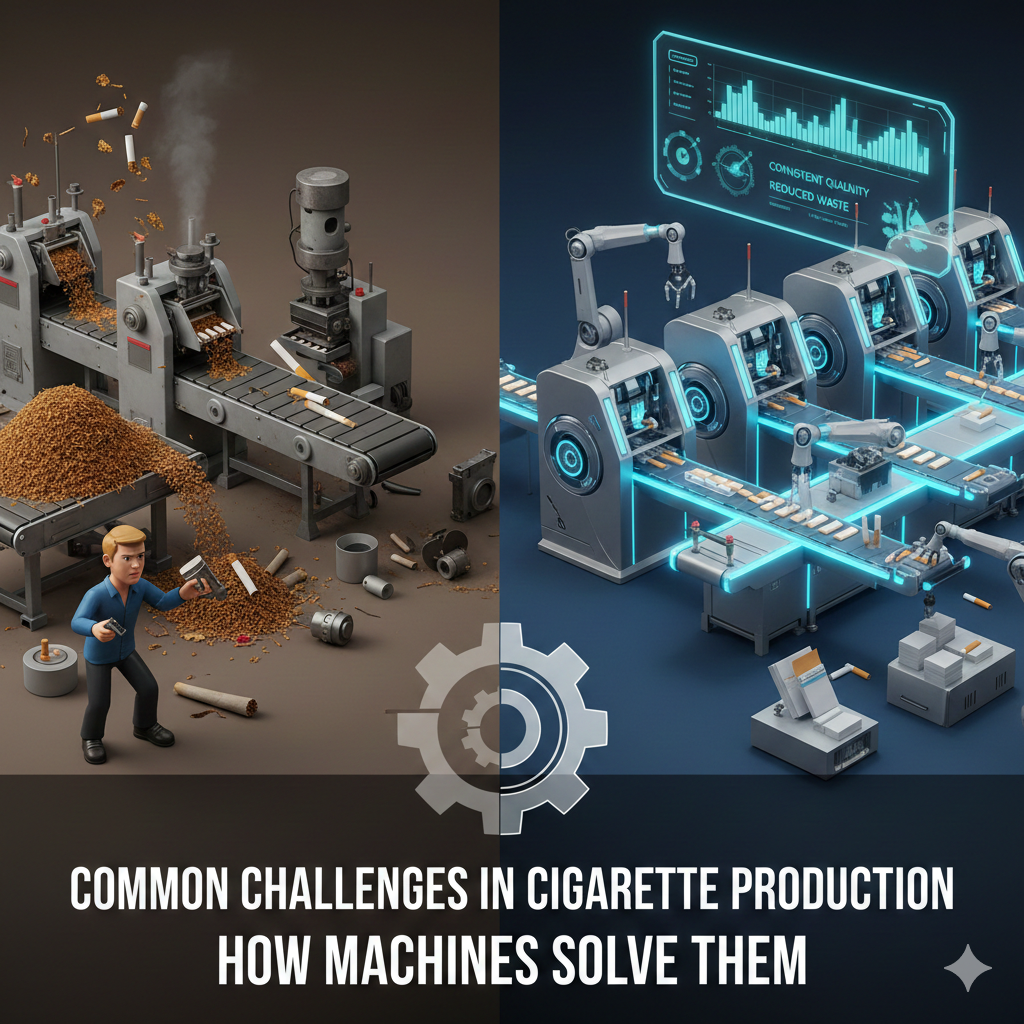
Cigarette manufacturing is a high speed, precision driven process where even minor inefficiencies can result in significant financial loss. From inconsistent tobacco filling to machine downtime and regulatory compliance issues, manufacturers face multiple operational challenges daily.
Modern solutions provided by experienced manufacturers like Marsons Group are specifically engineered to overcome these obstacles through automation, precision control, and intelligent monitoring systems.
This article explores the most common challenges in cigarette production and explains how advanced machines effectively solve them.
Challenge 1: Inconsistent Tobacco Weight and Density
Maintaining consistent tobacco weight and rod density is critical for product quality. Variations can affect burn rate, draw resistance, and overall customer experience.
Common Causes
Irregular tobacco feeding
Moisture imbalance
Mechanical instability
Manual adjustments
Machine Based Solution
Modern cigarette machines use automated weight control systems and density sensors that continuously monitor and adjust tobacco flow in real time. Precision compression units ensure uniform rod formation throughout production.
Impact on Production
| Issue | Without Advanced Machines | With Modern Machines |
|---|---|---|
| Weight Variation | Frequent | Minimal |
| Product Rejection | Higher | Reduced |
| Quality Consistency | Inconsistent | Uniform |
Automated correction mechanisms significantly improve overall product reliability.
Challenge 2: High Downtime and Frequent Breakdowns
Unexpected machine stoppages reduce daily output and increase operational costs. Older systems often suffer from mechanical wear and outdated components.
Machine Based Solution
Next generation equipment incorporates:
Predictive maintenance systems
Automatic lubrication technology
Real time diagnostics
Durable high quality components
These features reduce mechanical stress and detect potential faults before they lead to major breakdowns.
Operational Benefit
Reduced downtime leads to higher productivity and improved delivery timelines.
Challenge 3: Excessive Tobacco and Material Waste
Tobacco is a valuable raw material, and excessive waste directly impacts profitability.
Common Waste Areas
Uneven tobacco distribution
Improper cutting
Paper wrapping errors
Filter misalignment
Machine Based Solution
Advanced cigarette machines optimize material usage through:
Precise tobacco feeding systems
Accurate rod cutting mechanisms
Controlled paper tension systems
Automated filter alignment
Material Efficiency Comparison
| Factor | Conventional Setup | Advanced Machinery |
|---|---|---|
| Tobacco Waste | Higher | Minimized |
| Paper Usage | Inconsistent | Optimized |
| Reject Rate | Noticeable | Reduced |
Improved material control increases yield and lowers production costs.
Challenge 4: Quality Control and Defect Detection
Manual inspection cannot keep pace with high speed production lines. Defective cigarettes may pass through unnoticed, affecting brand reputation.
Machine Based Solution
Integrated inspection systems use sensors and automated rejection units to detect:
Incorrect weight
Filter positioning errors
Improper sealing
Length inconsistencies
Defective units are automatically removed without interrupting the production flow.
Challenge 5: Rising Labor Costs
Manual operations increase labor dependency and operational expenses. Additionally, human error may cause inconsistencies.
Machine Based Solution
Modern cigarette machines integrate high levels of automation, reducing the need for manual intervention. Touchscreen control panels and programmable logic controllers simplify operation and supervision.
Automation improves efficiency while optimizing workforce utilization.
Challenge 6: Compliance with Safety and Regulatory Standards
Manufacturers must comply with evolving safety regulations and industrial standards.
Machine Based Solution
Advanced machines include:
Improved dust extraction systems
Safety guarding mechanisms
Emission control features
Accurate batch tracking
These features help maintain regulatory compliance and create safer working environments.
Overall Performance Improvement
Upgrading to modern cigarette production machinery enhances multiple aspects of manufacturing.
Factory Performance Overview
| Area | Traditional Systems | Modern Automated Systems |
|---|---|---|
| Production Speed | Limited | High speed |
| Downtime | Frequent | Reduced |
| Quality Control | Manual | Automated |
| Material Utilization | Moderate | Optimized |
| Compliance | Basic | Advanced and integrated |
The result is a more stable, scalable, and cost effective production process.
Frequently Asked Questions
What is the most common issue in cigarette production
Inconsistent tobacco weight and machine downtime are among the most frequent challenges manufacturers face.
How do modern machines reduce waste
They use automated feeding, precision cutting, and real time monitoring to control material usage accurately.
Can old production lines be upgraded
Yes, many factories can modernize existing lines by integrating advanced modules after technical evaluation.
Do automated machines completely eliminate defects
While no system is perfect, automated inspection significantly reduces defect rates compared to manual checks.
How does automation impact profitability
Automation increases output, reduces waste, lowers labor costs, and improves consistency, all of which enhance profit margins.
Conclusion
Cigarette production involves multiple technical challenges that can affect efficiency, quality, and profitability. However, modern machinery provides practical solutions through automation, precision control, and intelligent monitoring systems.
By investing in advanced cigarette manufacturing equipment, businesses can overcome production challenges and achieve sustainable growth.
If you are looking to improve production efficiency and solve operational challenges, contact Marsons Group today to explore high performance cigarette machine solutions tailored to your factory needs.