Most operators automate too late. The pre-roll category generated roughly $3.6 billion across 383 million units in 2025, with unit sales climbing 18.6 percent against total market growth of just 1.5 percent, and more than 63,000 new pre-roll products launched in a single year. In a category moving that fast, hand rolling for one quarter too long costs you more than labour, it costs shelf space you may not recover. Whether you are weighing up a cannabis pre roll machine for high THC flower or scaling a low THC line on a Hemp Cigarette Making Machine, the timing question has a measurable answer sitting in your own production data.
The Volume Threshold Where Hand Rolling Stops Working
The published benchmarks converge around a clear range. A full-time hand-packer produces roughly 500 to 800 joints per day, at an annual labour cost of approximately $28,800 to $40,000. Hand packing itself takes 36 to 72 seconds per unit. By most industry analysis, a cannabis pre roll machine becomes worth the investment above about 1,000 joints per day, and some operators argue hand rolling stops being viable above 500 units per week unless your labour is effectively free. Two employees hand-packing and closing 5,000 joints a day represent roughly $115,000 to $160,000 in annual labour. Set against that, a mid-tier machine takes the same people from 50 to 100 units per hour to somewhere between 500 and 1,500, which is a five to fifteen times capacity gain without adding headcount.
Four Signals You Have Already Passed the Threshold
Labour Cost Per Unit Is Climbing, Not Falling
This is the signal most operators miss, because it contradicts normal manufacturing logic. Under manual production, labour cost per unit does not decrease with volume, it increases, because hand packing gets less efficient as batch sizes grow. The cost ladder makes the point plainly. A trained roller producing 45 to 55 units per hour puts labour at roughly $0.27 to $0.33 per unit at a $15 hourly rate, and considerably higher once you apply a fully loaded rate of $28 to $40. Semi-automated filling brings that to about $0.12 to $0.15 per unit. Fully automated systems reach $0.04 to $0.06. If your per-unit cost is rising as you scale and hiring is not fixing it, the curve is already working against you.
Weight Variance and Reject Rates Are Widening
No operator tamps material identically hundreds of times an hour across multiple shifts. Fatigue, speed pressure and differences between people introduce drift that compounds with volume. The return data reflects it: hand-rolled product generates return rates in the region of 14 to 18 percent, semi-automated filling cuts that to 6 to 9 percent, and fully automated systems land at 3 to 5 percent. Those returns are not just replacement cost. Inconsistent product invites budtender pushback and deeper discounting, which erodes margin and brand trust at the same time.
You Are Turning Down Orders or Missing Restocks
Capacity constraints rarely announce themselves as a crisis. They show up as an order you quietly decline, a dispensary restock that slips by a week, or a seasonal spike you cannot cover. If your production ceiling has started deciding your sales ceiling, the equipment decision has already been made for you and you are simply delaying it.
Your Hidden Labour Is Growing in the Shadows
Teams log rejects but rarely log touches, and a pre-roll handled twice costs more than one scrapped once. Rework, retraining, changeovers, supervision and micro-pauses seldom get assigned to pre-rolls in any report. Track four numbers for a fortnight: overtime hours tied to pre-roll production, rework minutes per 1,000 units, total pause minutes per shift, and lost output per new hire during ramp-up. Most operations find their true labour cost sits well above what their spreadsheet claims.
The Automation Ladder: Nobody Jumps Straight to Full Automation
Stage One: Manual Trays and Assisted Filling
Multi-cone trays and vibration-assisted filling roughly double hand-rolling throughput for a few hundred dollars. This stage suits operations under about 1,000 units per day, along with small batch and craft producers who genuinely need the flexibility. It is also the right place to prove your material prep before spending real capital.
Stage Two: Tabletop and Mid-Tier Machines
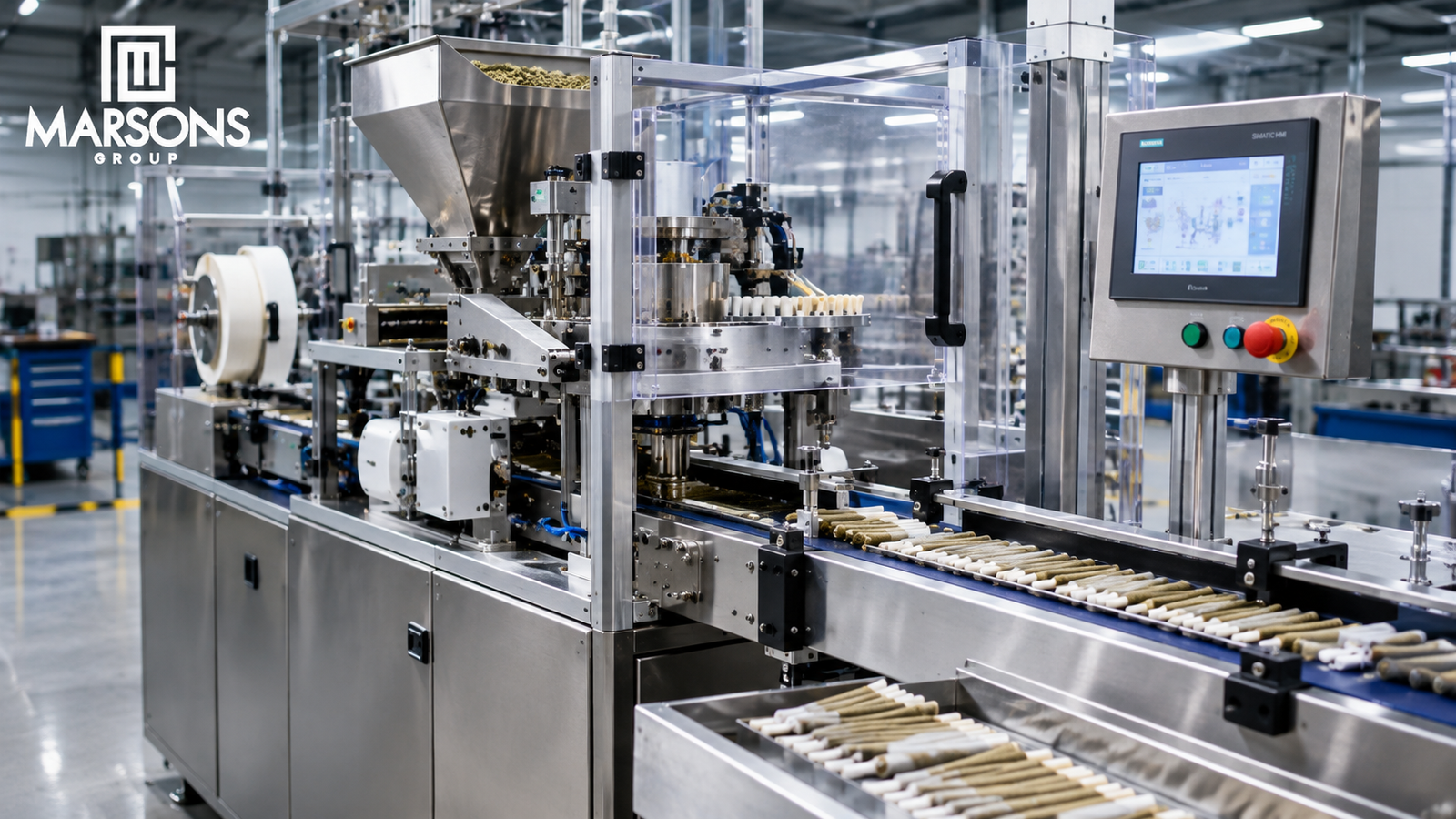
This is where most growing operations should be, and where automated pre roll production genuinely begins. Tabletop and mid-tier units deliver several hundred to a couple of thousand finished units per hour depending on tray capacity and operator rhythm, at capital costs measured in thousands rather than tens of thousands. Before committing at this tier it is worth understanding precisely what the equipment does to the product, and Cannabis Cigarette Machine: How It Works & Why You Need One walks through the filling, packing and sealing sequence stage by stage. Machines at this level typically replace two to three hand-closers and pay back in labour savings within months rather than years.
Stage Three: High Output and Integrated Lines
Fully automated systems fill, pack, tamp, weigh and close with minimal intervention, running autonomously for hours and producing between 1,000 and 3,000 units per hour. They make sense for operations that genuinely need 2,000 or more per hour. Two caveats matter. These machines need a climate-controlled room for both temperature and humidity, and while they demand less labour, the work is more nuanced and requires more training. Where team turnover is high, constant retraining creates downtime that meaningfully extends payback.
What Automation Does Not Fix
Automation standardises your process, it does not rescue your inputs. Pre-rolls sit at the intersection of agricultural variability and manufacturing precision, and moisture, grind size and packing density decide performance before the filler ever touches the material. Target moisture sits roughly in the 10 to 14 percent range, with flower around 55 to 62 percent relative humidity grinding and burning most predictably. Canoeing, the complaint operators hear most, is usually a grind and fill-consistency problem rather than a flower problem, driven by inconsistent particle size, over-grinding into powder and uneven moisture. The production day is decided in prep, not at the machine. Automating inconsistent material simply produces inconsistent pre-rolls faster and at greater expense.
Automation for Cultivators Versus Dispensaries
Scaling Equipment on the Cultivation Side
For cultivators, the automation case is really a yield case. Cannabis cultivator equipment scaling decisions are driven by what happens to smalls and B-buds, which are exactly what most full-flower pre-rolls are built from, with trim reserved for value tiers and all-trim product being too harsh to build a brand on. Rather than selling that material into a compressed bulk market, in-house pre-roll production converts it into a finished SKU at retail pricing. That changes the payback calculation entirely, because the machine is not only displacing labour, it is repricing a portion of every harvest.
In-House Production at Retail
The retail case is a margin case, and the numbers are stark. House brand pre-rolls cost dispensaries an average of $2.40 and deliver around 55 percent margin, against $5.19 and 46.2 percent for outside brands. That gap is why dispensary automation pre-roll programmes keep appearing on the roadmap. Be honest about the alternative, though. Co-packers running fully automated lines charge roughly $0.35 to $0.65 per unit, which can be 20 to 40 percent cheaper than in-house production once labour overhead, depreciation and opportunity cost are counted. Outsourcing deserves a serious look above roughly 2,000 units a week before you commit capital.
Choosing the Right Machine for Your Stage
Match the machine to your current daily volume target rather than your aspirational one, then buy slightly ahead of it. Factor in lead time, installation, operator training and the validation runs needed before output is saleable, because buying at the moment of pain means arriving several months late. Test any machine on your own material before committing, since moisture, grind and stem content change performance in ways a demonstration with someone else’s flower will never reveal. Marsons Group makes the same point about industrial rolling equipment generally: a trial run on your actual blend tells you more than any specification sheet, and it is the step buyers most often skip.
Conclusion
Run one calculation this week. Take your monthly pre-roll output, divide by the total labour hours genuinely spent producing it including rework and supervision, and multiply by a fully loaded hourly rate. Compare that per-unit figure against the $0.12 to $0.15 a semi-automated setup typically achieves. If the gap multiplied by your annual volume exceeds the cost of a mid-tier machine, you passed the threshold some time ago.
The deeper point is that automation timing is about the direction of your cost curve, not the size of your operation. Manual production carries a cost per unit that rises as you grow, and no amount of hiring reverses that. The operators who scale profitably in this category are the ones who noticed the curve bending early, fixed their material prep first, and bought equipment while they still had the margin to pay for it comfortably rather than the desperation to pay for it urgently.