Pre-rolls are no longer a side product. The category moved more than 383 million units and generated around $3.6 billion in 2025, taking close to a 16 percent share of total cannabis sales, with unit growth running far ahead of the wider market. That success has changed the buying question for producers. Anyone searching for a pre roll machine for sale today is not really choosing between brands or price tiers. They are choosing between two production philosophies: a single purpose machine that does one thing at very high speed, or a platform that runs several formats using interchangeable tooling. Whether you are producing high THC flower or scaling a low THC line on a Hemp Cigarette Making Machine, the same trade-off decides your cost per unit for the next five years.
What Actually Separates the Two Machine Types
How a Dedicated Pre Roll Machine Works
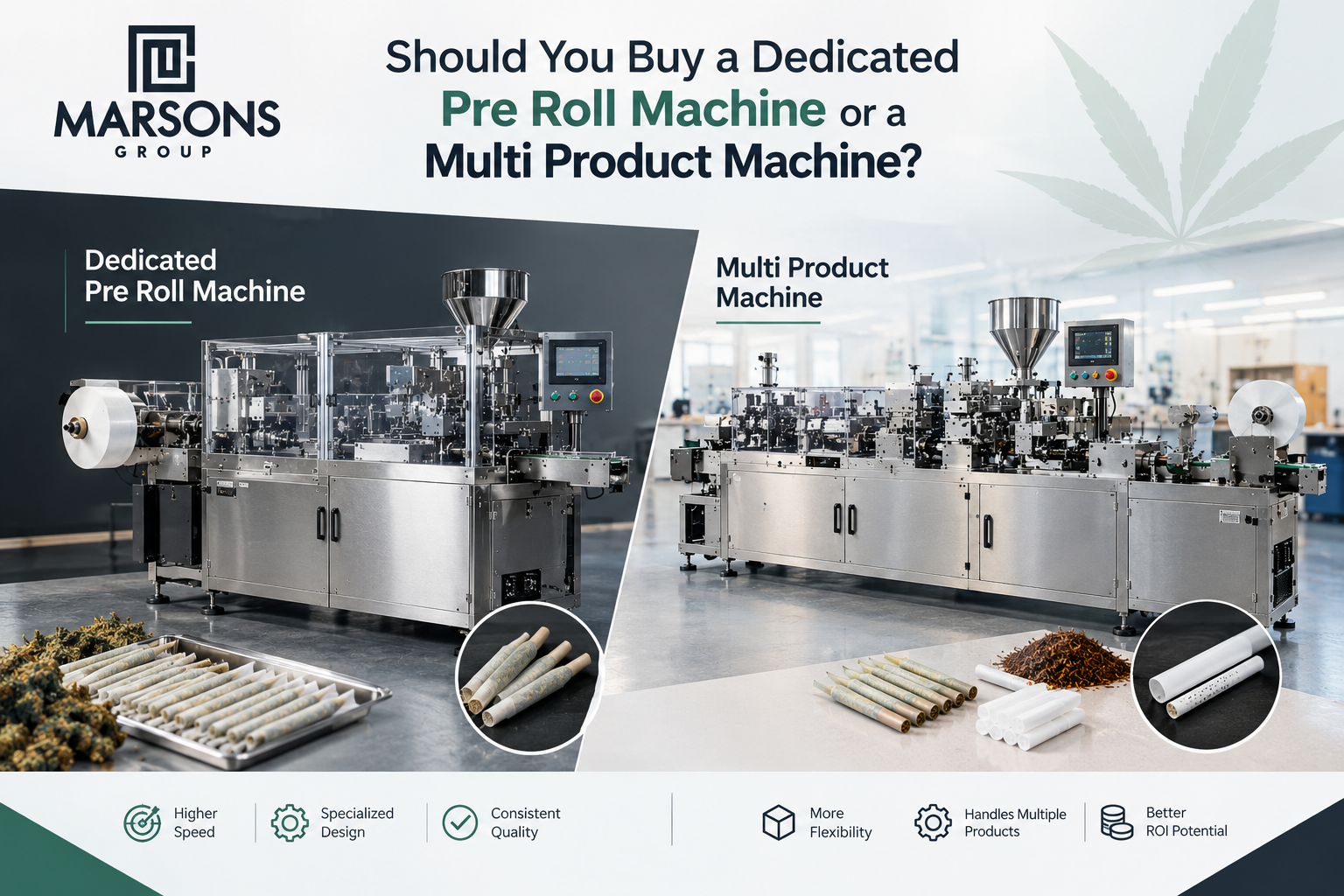
A dedicated machine is engineered around one fill method and a narrow range of cone sizes. Ground flower is metered volumetrically, settled into pre-formed cones using calibrated vibration or tamping, then closed with a twist or a folded crown finish. Everything in the mechanism, from hopper geometry to vibration frequency and tamping pressure, is tuned for a specific material behaviour and a specific cone. Because the tolerances are fixed, output stays predictable across shifts. Operators learn one workflow, maintenance covers one set of wear parts, and batch documentation stays simple because nothing structural changes between runs. That narrowness is not a limitation. It is the entire point of the design, and it is why single purpose machines tend to hold their accuracy longer under real production conditions.
How a Multi Product Platform Works
A multi product platform separates the base unit from the format tooling. The frame, motor and control system stay in place while trays, pods, metering plates or garniture parts are swapped to change what the machine produces. On tabletop and mid-tier systems this usually means colour coded inserts covering 70mm dogwalkers, 84mm half grams, 98mm cones, 109mm king size cones and wider blunt tubes holding up to two grams. On industrial rod forming equipment it means replacing format parts to change rod diameter or length, with some modern makers combining rod forming, tipping, inspection and cutting into one configurable line. The principle is identical at both scales. You are buying one capital asset plus a library of tooling instead of several separate machines, which is where the dedicated pre roll machine vs multi product platform question really begins.
Throughput, Consistency and Cost Per Unit
Throughput is the number most buyers get wrong. A common mistake is assuming more holes per tray means more units per hour. It does not. Real output is cycle time multiplied by tray capacity, so a 169 cone tray on a ninety second cycle yields roughly 6,760 cones per hour, while a higher capacity tray with a slower cycle and awkward handling may deliver considerably less. Independent single operator testing of leading tabletop units produced results between roughly 530 and 840 finished pre-rolls per hour, rising to between 1,000 and 1,360 per hour once a second operator and spare parts were added. Fully automated systems typically sit in the 1,000 to 2,000 per hour band, and high speed industrial makers built for hemp blends run far beyond that. Set against manual teams averaging 100 to 150 joints per labour hour, the labour arithmetic is what actually funds the purchase.
The Case for a Dedicated Pre Roll Machine
If one or two SKUs carry most of your revenue, a dedicated machine is almost always the stronger buy. Single purpose equipment is faster to validate, faster to train staff on and easier to document for compliance, because fill weight, density and closure method never change between batches. Fewer adjustable variables also means fewer failure modes and a shorter fault-finding list when output drifts. Weight giveaway is the quiet margin killer in pre-roll production, and a machine locked to one cone size holds calibration far longer than one reconfigured every week. There is also a workflow benefit that rarely appears on a spec sheet. Operators running the same format every shift develop rhythm, and rhythm is worth more per hour than any advertised cycle time. For producers pushing a core half gram or one gram line at volume, depth beats breadth every time. If you are still mapping the mechanics of automated filling before comparing specifications, Cannabis Cigarette Machine: How It Works & Why You Need One breaks the sequence down stage by stage.
The Case for a Multi Product Platform
Flexibility earns its price when your product mix is genuinely mixed. Infused pre-rolls now account for roughly 47 percent of category revenue and are the fastest growing segment in both units and sales, while multi-pack formats make up close to half of all SKUs on shelf. Serving that mix means running more than one diameter and more than one fill weight, often in the same week. A flexible rolling machine cannabis producers can reconfigure lets you launch a dogwalker multi-pack or a premium infused king size without waiting on a second capital approval and a three month lead time. It matters even more in contract manufacturing, where the client dictates format and your competitive advantage is simply being able to say yes. One honest caveat: pre-rolled blunts still represent under one percent of category sales, so buy tooling for formats your market actually purchases, not formats that sound impressive.
The Hidden Cost of Flexibility: Changeover and Calibration
Every changeover is unproduced product, and this is the line item buyers consistently underestimate. On tray and pod systems, swapping tooling is quick, but recalibrating for a different strain, a different grind or a different moisture level takes production offline while operators dial weights back in. On industrial rod makers, changing diameter means unbolting and refitting format parts individually, a slow procedure during which the machine earns nothing at all. Infused production sharpens the problem further, because sticky, resin rich blends and narrow concentrate injection nozzles are prone to residue build up, clogging and dosing drift if the line is not cleaned properly between runs. Before you buy flexibility, price it honestly. Multiply realistic changeover time by hourly output and monthly format switches, and you will see exactly what that optionality costs per year.
Cannabis Equipment Flexibility and Market Volatility
Equipment decisions get made inside a market that keeps moving underneath them. Wholesale pricing fell across most major categories in the most recent cycle, with pre-rolls down roughly ten percent, while SKU proliferation tightened pricing bands and widened the gap between premium and value tiers. Cannabis equipment flexibility works as a hedge against exactly that. If a format stalls or a new one takes off, buying tooling is dramatically cheaper than buying a second machine or outsourcing the run. That hedge is worth most to producers moving between high THC and low THC lines, since hemp biomass behaves very differently from resin dense flower and cross compatibility should always be confirmed with the manufacturer rather than assumed. The counterweight is real, though: mature market operators are deliberately cutting SKU clutter and standardising hardware, because complexity erodes margin when it serves no roadmap.
Total Cost of Ownership and What to Ask Before You Buy
Purchase price is the smallest part of this decision. Tabletop units start near $1,800 to $2,000, mid-tier systems run from roughly $6,600 to $25,000, high output automated machines reach $60,000 or more, and fully automated enterprise lines exceed six figures. Most operators report recovering the investment in purpose-built equipment within about six to eighteen months, depending on volume and labour displaced. Build your model around tooling sets, spare parts availability, service response time, operator hours and floor space rather than headline speed. Marsons Group makes two practical points worth repeating: unusually low quotes usually signal something removed from the build, and skipping a trial run on your own material is a common and expensive mistake. For used or rebuilt equipment, always request running hours, full service history and video of the machine running at full speed.
Which Option Fits Your Operation?
Choose dedicated if one or two SKUs drive most of your volume, your formats are stable, and your bottleneck is simply units per shift. Choose a multi product platform if you run infused and non-infused lines side by side, serve contract clients, or expect your format mix to shift within the next eighteen months. If you are genuinely undecided, buy the dedicated machine for your core SKU first and add flexibility as a second asset later, because a fast machine running your best seller is what pays for the second machine. The one scenario that reliably ends badly is buying a versatile platform to postpone the decision, then running a single format on it for two years while carrying the cost and complexity of capability you never use.
Conclusion
The dedicated versus multi product decision is not a technical question, it is a business model question wearing technical clothing. Specifications will not answer it for you, because both machine types work well when matched to the right operation and both disappoint when matched to the wrong one. What settles it is an honest reading of your own numbers: how many SKUs actually generate revenue, how stable those formats have been over the last twelve months, how much of your output is contracted to someone else’s specification, and how much unproduced product you can absorb every time the line is reconfigured.
Work through that before you shortlist equipment. Pull twelve months of sales by format, calculate your true cost per unit including labour and weight giveaway, and project your SKU mix eighteen months forward rather than assuming today’s mix holds. Producers who do this usually find the answer was sitting in their own data the whole time. One last piece of advice that applies whichever route you take: test the machine on your own material before money changes hands, because moisture content, grind consistency and stem content all change performance in ways a demonstration with someone else’s flower will never reveal. Equipment is one of the few decisions in this industry you cannot iterate your way out of, so buy for the operation you will be running in three years, not just the one you are running this quarter.