Some machines stick around because they are genuinely good at what they do. Not because they are the newest option on the market or because someone ran a clever marketing campaign around them. They stick around because production managers keep buying them, running them, and coming back for more when it is time to expand. The Sasib 3000 cigarette machine for sale keeps showing up in searches and supplier listings across multiple continents for exactly that reason. It has a track record that speaks for itself, and for manufacturers who need reliable soft pack production without the complexity of newer systems, it remains a serious option worth understanding properly before you buy.
What the Sasib 3000 Actually Does
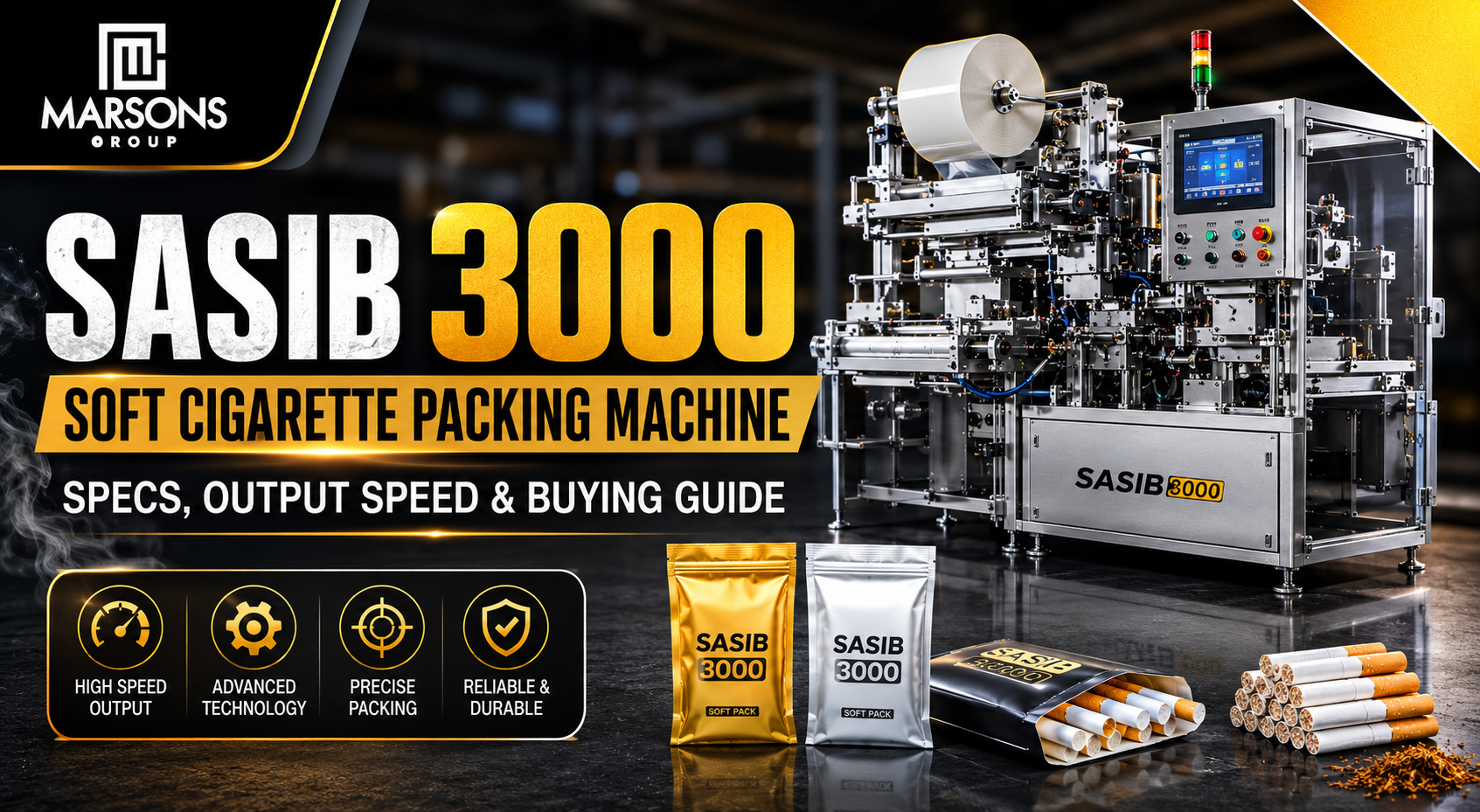
The Sasib 3000 soft cigarette packing machine is a soft pack wrapping machine. Its job starts after cigarettes have already been made. It takes the grouped cigarettes, applies the inner foil lining, wraps the outer paper cup around the group, folds everything into the finished soft pack shape, and seals it. The result is the classic soft cup format that still dominates in several markets across Africa, parts of Asia, and Eastern Europe.
This is not a making machine. It does not produce cigarettes. It is purely on the packing side of the production line, and it does that job with the kind of consistency that comes from a design that has been refined over many years of commercial use.
The Specifications Worth Knowing
Output is the first number most buyers ask about, and for good reason. The Sasib 3000 runs at up to 300 packs per minute under optimal production conditions. For most mid to large scale soft pack operations, that rate is more than adequate and pairs well with the output capacity of standard commercial cigarette making machines.
The machine operates as a full-automatic system. Once the cigarette group enters the feed, the entire wrapping sequence runs through to the finished sealed pack without manual intervention. Foil application, paper wrapping, folding, and sealing all happen in a single continuous process.
Electrically, the Sasib 3000 soft pack machine runs on standard industrial voltage, typically 220V and 380V configurations depending on the specific unit. The mechanical footprint is significant but manageable for most purpose-built production floor layouts.
The machine uses a combination of mechanical and pneumatic systems. The mechanical side handles the structural work, the forming, the folding, and the precision wrapping. The pneumatic side manages actuation and transfer between stages. Together they give the machine a reliable and predictable operational rhythm that experienced operators pick up quickly.
One thing worth noting about the Sasib 3000 is the relatively accessible mechanical layout. Components are not buried inside complex assemblies. When something needs attention, it is usually not difficult for a trained technician to find and fix the issue without extended downtime. That accessibility is one of the practical reasons the machine has remained popular even as newer designs have entered the market.
Soft Pack Format and Where It Still Matters
Hard box has grown its market share significantly over the past two decades. Regulatory requirements, premium brand positioning, and consumer preference shifts in many Western markets have all pushed in that direction. But soft pack has not disappeared. Not even close.
In markets where price sensitivity drives purchasing decisions, soft cup format has real advantages. The material cost per pack is lower than hard box. The production process involves fewer steps and less complex machinery. And in many markets, there is a consumer base that has grown up with soft pack and simply prefers it. For manufacturers targeting these markets, the Sasib 3000 soft cigarette packing machine is not a compromise choice. It is the right tool for the job.
What to Check Before You Buy?
Start with running hours. Ask the seller directly how many hours the machine has logged and what kind of production environment it was running in. A machine that has been running three shifts a day in a high-volume facility is in a very different mechanical state than one that has had lighter use and regular servicing. Both can still be good buys depending on price and condition, but you need to know what you are working with.
Service history is the next thing to pin down. Ask for whatever records exist. They will not always be complete, but what is there tells you something about how the machine was treated between service intervals. A seller who cannot produce any maintenance documentation at all is worth approaching with caution.
The foil application mechanism deserves specific attention on any used Sasib 3000. This is one of the areas that accumulates wear fastest during high-volume soft pack production. Ask about the condition of the foil feed rollers, the tension system, and the cutting mechanism. Any inconsistency here shows up directly in pack quality.
The cup-forming section is the other area to look at carefully. The folding tools and forming guides in this section handle repetitive high-speed motion throughout every production shift. Worn tooling here produces packs with poor edge definition and inconsistent sealing. Ask when these components were last replaced or reconditioned.
If at all possible, ask the seller to run the machine at full production speed before any purchase is finalized. Watch a run of finished packs and inspect the output. Consistent foil application, clean folds, and tight seals across the sample tell you the machine is performing properly. Any variation in the output is a signal that something needs attention before the machine goes into production at your facility.
For a broader view of what is currently available in packing equipment, the cigarette packing machines page on the Marsons Group website lists current inventory with full specifications. It is worth going through when you are comparing options across different suppliers and formats.
Spare Parts and After-Sales Support
The Sasib 3000 has been in commercial production long enough that spare parts are available through established tobacco machinery suppliers. This is an important practical consideration. A machine with a well-supplied parts market is one you can keep running without depending on a single supplier or waiting weeks for components to arrive from overseas.
Before finalizing any purchase, ask your supplier directly about parts availability for the specific components most likely to need replacement. Foil feed components, forming tools, and pneumatic fittings are the areas to ask about first. A supplier who stocks these or can source them quickly is giving you something valuable alongside the machine itself.
Marsons Group supplies spare parts for a wide range of tobacco machinery including the Sasib 3000, and their technical support team is available to help identify the right components for your specific machine configuration. For manufacturers who want a single reliable source for both equipment and ongoing support, that combination matters.
Where Marsons Group Fits In?
Marsons Group has been operating in the tobacco machinery space since the 1960s. Their experience covers a wide range of markets, machine types, and production scales. When it comes to the Sasib 3000, they bring both the equipment and the knowledge to make sure the machine you buy is properly matched to your production line.
Their after-sales structure includes installation support, technical assistance, and spare parts supply. For anyone buying a Sasib 3000 cigarette machine for sale, knowing that support is available after the purchase is not a small thing. It is what separates a long-term production asset from an expensive headache.
Conclusion
The Sasib 3000 is a proven soft pack machine with a long commercial history behind it. The output speed, the accessible mechanical design, and the available parts supply all make it a practical choice for manufacturers who need reliable soft cup production at scale. But as with any significant equipment purchase, the condition of the specific unit and the quality of the supplier relationship determine whether the investment actually pays off. Take the time to ask the right questions before you commit, and you are in a much stronger position to get a machine that works properly from day one. To better understand the Role of Automation in Cigarette Packing Machines, it is worth exploring how automation continues to improve production efficiency, consistency, and long-term operational reliability across modern tobacco packaging lines.