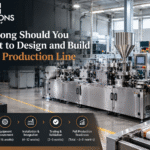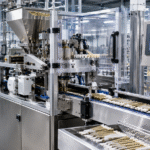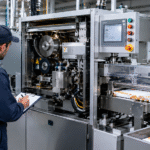
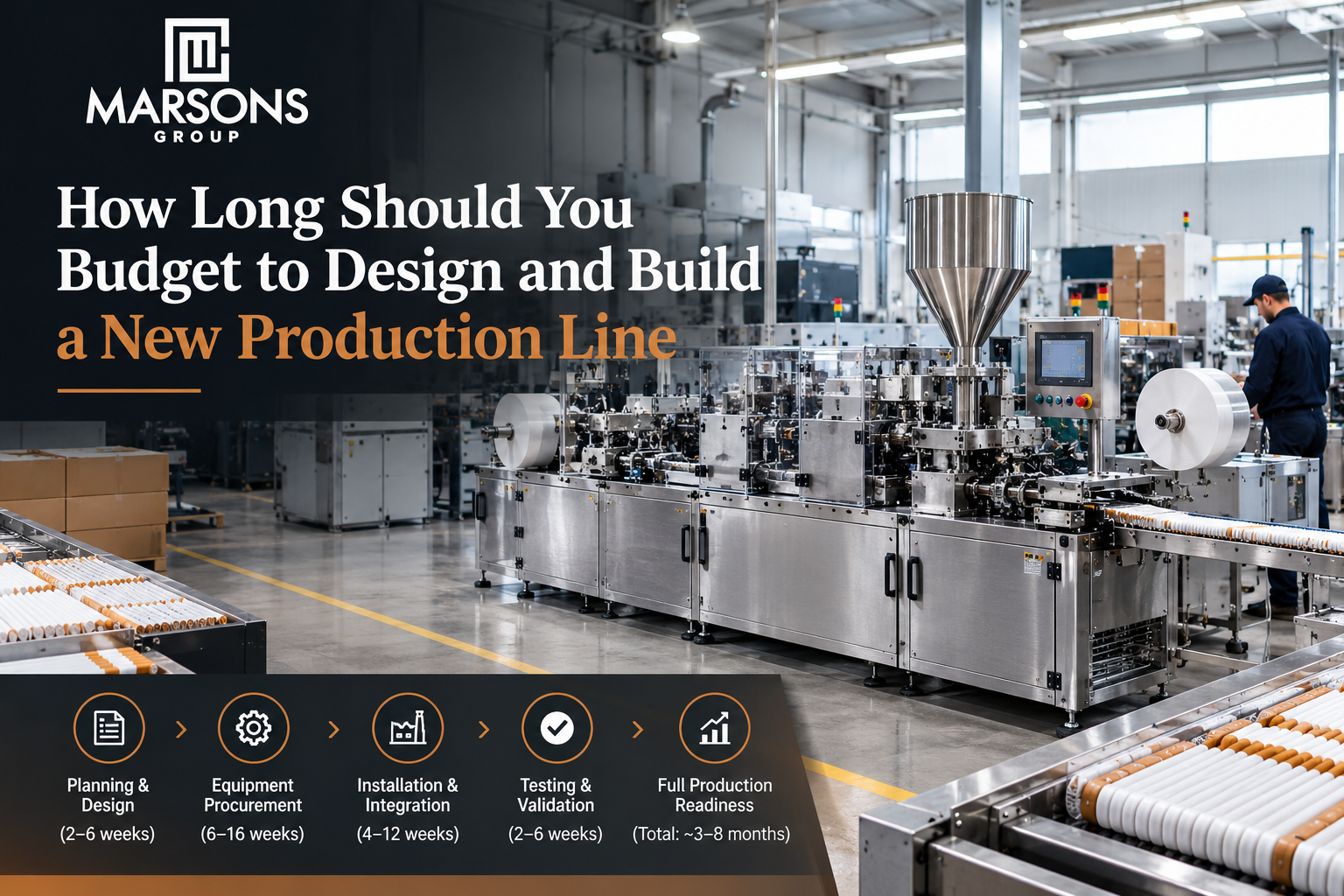
Most people planning a new manufacturing facility underestimate the schedule by a factor of two, and almost always for the same reason. They budget carefully for the machines and forget that the machines are the one thing they cannot hurry. The moment you begin comparing options in the market for Tobacco Machinery for Sale, you are effectively setting your launch date, because equipment delivery is the longest and least flexible item in the entire programme. Whether you are adding a single line to an existing building or commissioning a complete plant from bare land, the honest answer sits between nine months and three years, and where you land inside that range is decided long before the first foundation is poured.
What a Realistic Factory Build Timeline Looks Like?
A single production line installed into a prepared, serviced building typically runs nine to eighteen months from approval to first saleable output. A complete greenfield plant, starting with land acquisition, runs eighteen to thirty months at the fast end. Consultants who manage large industrial programmes describe the full greenfield journey as a three to five year process when land, utilities and multi line capacity are all in scope. That upper figure is not pessimism, it is what happens when every dependency runs in sequence instead of in parallel. The useful planning number for most private investors is twelve to twenty four months. Anything shorter assumes equipment already on the water, a building already standing, and approvals already granted.
Phase One: Feasibility, Capacity Planning and Concept Design
Budget four to eight weeks. This phase answers three questions that govern everything after it: what you will produce, how much of it per shift, and what you are willing to spend. Capacity is the decision with the longest shadow. The machinery market spans a wide band, from makers running at 5,500 cigarettes per minute through mid speed units at 8,500 cpm, up to double rod makers at 10,000 to 16,000 cpm and complete high speed lines reaching 20,000 cpm. Each tier implies different floor area, different power draw, different operator counts and different conditioning capacity. Choosing a target output late, or changing it in month seven, is the single most expensive schedule mistake available to you. Lock the capacity envelope here, in writing, before any supplier is approached.
Phase Two: Detailed Production Line Design and Plant Layout
Budget six to twelve weeks. Proper production line design converts your capacity target into drawings a contractor and a machinery supplier can both build against. It covers material flow from leaf intake through primary processing, conditioning, making, packing and warehousing, plus the service routes that make all of it work: compressed air, dust extraction, waste return, electrical distribution and operator access. Good production line design also plans the second line you have not bought yet, leaving the bay width, the utility headroom and the floor loading to accept it without demolition. Expansion designed in now costs drawings. Expansion retrofitted later costs production downtime.
Why the Design Stage Quietly Controls Your Launch Date?
Detailed engineering is the phase people shorten to save time, and it is the phase that most reliably destroys schedules when shortened. Project reviews of delayed industrial programmes name the same culprits repeatedly: delays in finalising detailed engineering, changes in project scope, and problems in tendering, ordering and equipment supply. Note that two of those three are design failures wearing a procurement costume. You cannot order accurately from an incomplete drawing set, and every revision issued after a purchase order becomes a change order with a cost and a delay attached to it.
Phase Three: Machinery Lead Time and the Factory Launch Date
This is your critical path, and it is largely outside your control. Industrial equipment lead times commonly run from three months to two years, because the clock covers engineering, manufacturing, testing and installation, not merely shipping. Standard equipment often quotes at eight to sixteen weeks, while configured and customised machinery stretches across an eight to fifty two week band. Suppliers have reported quoted estimates fluctuating by fifty to two hundred percent against reality, with machines that once needed twelve weeks now taking twenty to thirty. Two traps deserve naming. First, a quoted lead time usually describes production time only, excluding shipping, customs and installation. Sea freight for heavy machinery adds twenty five to sixty days on its own, and supplier shutdowns around Chinese New Year can add a further three to five weeks. Second, long lead equipment now represents roughly thirty five to forty percent of total capital expenditure on technical industrial projects, which means your payment schedule and your delivery schedule are the same conversation.
Phase Four: Civil Works, Utilities and Site Readiness
Budget three to six months, running in parallel with machinery manufacture rather than after it. Pre engineered steel buildings are the standard choice precisely because they compress this phase, with most projects completing within eight to twenty weeks from design approval to handover, against twelve months or more for conventional construction at similar scale. Site preparation proceeds while components are fabricated, so erection begins the moment the package arrives. The real risk here is not the shell, it is the services inside it. Climate control is a process requirement in tobacco manufacturing, not a comfort feature. Most cigarette production areas are held at sixty five to sixty eight percent relative humidity, and holding sixty five percent plus or minus five is critical to both output and product quality. Processing areas sit at twenty to twenty four degrees Celsius with sixty to seventy percent RH, while storage runs nearer seventy to seventy five percent. Specify that HVAC early, because equipment of this type has reached lead times of up to fifty two weeks in stressed markets.
Phase Five: Installation, Commissioning and Trial Production
Budget six to twelve weeks, and resist the urge to shrink it. Acceptance testing happens twice. Factory acceptance testing is performed at the supplier’s works before shipment, reproducing real operating conditions, and it is a process rather than an event, capable of extending across several weeks. Site acceptance testing follows installation and verifies the complete line under your conditions, with your power, your humidity and your materials. Commissioning duration is driven by line complexity, the number of integrated modules and, critically, the readiness of your site. A line delivered into an unfinished building does not commission faster, it simply waits in crates while warranty periods tick away.
A Phase by Phase Cigarette Factory Setup Timeline
For a single line into a prepared building, a realistic cigarette factory setup timeline looks like this:
- Feasibility and concept design: 4 to 8 weeks
- Detailed design and layout: 6 to 12 weeks
- Machinery manufacture and delivery: 20 to 40 weeks
- Civil works and utilities: 12 to 24 weeks, parallel
- Installation and commissioning: 6 to 12 weeks
- Trial production and ramp up: 4 to 8 weeks
Sequenced properly, with civil works overlapping machinery manufacture, that totals roughly eleven to sixteen months. Sequenced badly, the identical scope takes twenty four. Because the capital drawdown follows this same sequence, it is worth mapping your funding milestones against the Cigarette Manufacturing Machine in Pakistan: Complete Factory Setup Cost Guide before you commit to any dates publicly.
Licensing and Regulatory Approvals: The Hidden Schedule Risk
In Pakistan, electronic production monitoring is mandatory under Section 40C(2) of the Sales Tax Act 1990 read with Rule 150ZF of the Sales Tax Rules 2006, and manufacturers may not remove tobacco products from the production site without affixation of tax stamps and Unique Identification Marking. The system now covers twenty three functional manufacturing units across Pakistan and Azad Jammu and Kashmir. The schedule lesson is written plainly in the record: the implementation deadline was pushed from April 2022 to May 2022, then extended again, because units were still in the testing phase. Treat stamping integration as a technical workstream with its own lead time, not a form to be filed in the final week before launch.
What Actually Causes Delays, and How to Avoid Them
Delay is the statistical norm rather than the exception. One multi project study found that only two of sixty five projects finished on the planned schedule, with an average slip of just over two years. The causes cluster tightly. Scope changes after ordering are the most common, followed by incomplete detailed engineering, financing drawdowns that lag payment milestones, and utility connections treated as somebody else’s responsibility. Supporting infrastructure deserves particular attention, since generator lead times across Asia and the Gulf extended from around fifty five to sixty weeks in 2024 to eighty five to ninety weeks through 2025 and into 2026. Your line can be fully installed and still sit idle if the power behind it is not ready.
How to Compress the Timeline Without Cutting Corners
You cannot compress manufacture, but you can compress almost everything around it. Order long lead items the day detailed design is frozen, not after civil tendering concludes. Run building works and machinery production concurrently rather than consecutively. Attend factory acceptance testing with the operators who will actually run the line, so training is underway before delivery rather than after it. Consider well maintained refurbished equipment, which can remove several months from the machinery lead time factory launch sequence at a materially lower capital cost. Marsons Group works with buyers at exactly this decision point, and opening that conversation during design rather than after it often reshapes a schedule more effectively than any amount of pressure applied later.
Planning Your Build With Dates You Can Defend
Build your programme backwards from the machinery delivery date, because that date anchors every other date you have. Add a contingency of fifteen to twenty percent to the total, place it visibly in the plan rather than hiding it inside individual tasks, and report progress against milestones that mean something: design frozen, order placed, FAT passed, building handed over, first saleable pack produced. A factory build timeline presented this way survives contact with reality. One built on optimism does not.
Conclusion
The question is not really how long a new production line takes, it is how much of that time you choose to spend in sequence rather than in parallel. Design, construction and procurement can overlap considerably. Machinery manufacture, shipping and regulatory integration cannot be rushed at all. Investors who accept that distinction early tend to launch inside twelve to sixteen months. Those who treat the schedule as a negotiation tend to discover the truth in month eighteen, with capital committed and no revenue arriving. Set your capacity target, freeze the design, place the long lead orders, and let everything else organise itself around those three decisions. A production line built to a realistic schedule starts earning sooner than one promised to an unrealistic one, every time.