Have you ever sat down at the end of a production week and wondered where the money actually went?
Orders went out. Workers showed up. The line kept moving. But the numbers still felt tighter than they should. This happens more than most factory owners talk about openly, and nine times out of ten, the answer is not one big problem. It is a hundred small ones bleeding the operation quietly from the inside.
Manual tobacco production does this particularly well. The waste from an inconsistent cut, the batch redone because the blend ratio was slightly off, the hour lost when three workers called in sick, and nobody told the supervisor until noon. None of it looks alarming on its own. Together, it adds up to serious money leaving the building every week without a clear explanation.
This is the conversation producers running on manual operations need to have honestly, because the right tobacco processing machinery does not just speed things up. It closes the gaps where money quietly disappears.
The Real Price of Running Things Manually
There is a version of manual operations that looks fine on paper. Steady headcount, predictable shifts, workers who know the process. That version exists and it feels comfortable to manage.
What it hides is harder to see. Manual tobacco production lines routinely lose between 8 and 12 percent of raw material before it becomes a finished product. On a 500 kilogram run that is 40 to 60 kilograms gone every single shift. Not from one big mistake. From dozens of small ones nobody individually considers worth flagging.
The cut that ran wide because the worker was four hours into a six hour stint. The blend that came out off because someone newer was estimating instead of measuring. The packaging slowdown because the team was short staffed and nobody said anything until the problem was already baked into the day.
These are not management failures. They are the nature of manual labor at scale. People get tired, make small errors, and leave. When the ones who genuinely knew the process walk out, you feel it for weeks in the quality and pace of whoever is learning to replace them.
Factor in overtime, rework on batches that missed specification, and supervisory hours spent troubleshooting problems a properly automated line would never produce. The cost per kilogram coming off a manual line is almost always higher than the payroll sheet suggests.
Where Automation Changes the Calculation?
Producers do not invest in tobacco processing machines just to run faster. Speed matters, but it is secondary to what actually drives the financial case.
What automation genuinely solves is inconsistency. A calibrated machine in hour eight produces the same output as hour one. No fatigue creeping into the cut width. No variation based on who is working that station today. The parameters you set at the start hold through the entire run.
Waste rates on well-maintained automated systems land between 2 and 3 percent. Against the 8 to 12 percent typical of manual operations, that difference is significant. On a 500-kilogram daily run, recovering an extra 30 kilograms of usable material adds up considerably across a full production month.
The labor picture shifts rather than disappears. Fewer people per unit of output, but the ones on the floor are doing more meaningful work. When volume grows you can add shifts without growing headcount at the same rate. That gap between rising output and controlled labor cost is where real margin improvement lives.
Modern tobacco processing machinery captures production data automatically at every stage. For operations exporting into regulated markets across Europe or the Gulf, that documentation is no longer optional. Manual operations simply cannot produce it consistently at scale.
What the Numbers Actually Look Like?
Take a mid-sized operation running two shifts at 500 kilograms per shift with around 18 workers. Include full labor costs, a 9 percent waste rate, and periodic rework. The cost per kilogram tends to surprise owners who have not broken it down properly before.
Put the same volume through an automated line with five operators. Waste drops. Output stabilizes. Extra capacity can be added without a proportional cost jump. Payback on quality tobacco processing machinery at that scale typically falls between 18 and 36 months depending on configuration and volume consistency.
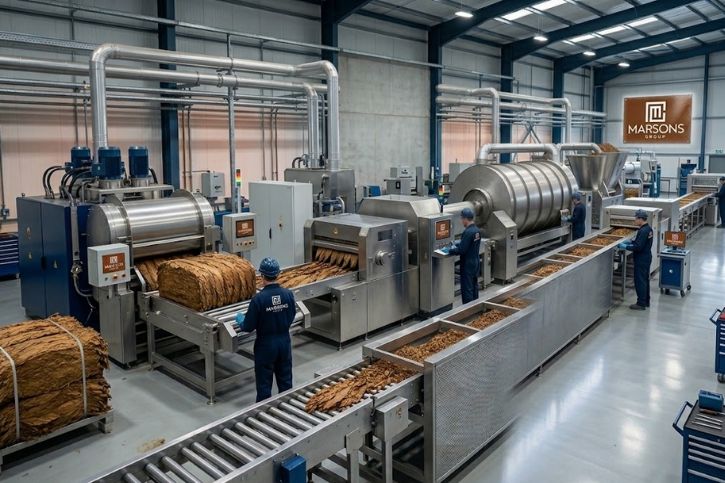
Marsons Group carries a strong range of tobacco processing machines built for different production scales, with installation support and technical assistance included. Their tobacco machinery spare parts availability is worth factoring in early since parts access directly determines how fast any downtime gets resolved.
When Manual Machines Still Make Sense?
Not every operation should be moving toward full automation, and it is worth saying that directly.
Small specialty batches with custom curing profiles or artisan blending requirements may not generate enough volume to justify the capital cost within a realistic timeframe. The numbers only work when throughput is consistently high enough to carry the investment across a reasonable payback period.
Many producers find the answer somewhere in the middle. Automate the highest volume, consistency-sensitive stages first, cutting, blending, and packaging are the obvious starting points. Keep experienced people where genuine judgment and sensory evaluation matter. This brings down upfront cost while still making a real dent in waste and output reliability.
Buying Smart When Looking at Tobacco Processing Machines for Sale
The market for tobacco processing machines for sale is broader than it was five years ago. More options at more price points is good news but it also creates more room to make the wrong call if the evaluation is not thorough.
After-sales support is where buyers most often regret not asking harder questions upfront. Equipment sitting idle for two weeks waiting on a part will erase months of efficiency gains in one stretch. Ask specifically about parts availability and realistic response times before committing to anything.
Scalability matters too. Equipment suited to your current volume needs a clear path to handle growth without requiring a full line replacement when output increases ahead of schedule.
Marsons Group has been in this industry since the 1960s with clients across the UAE, Europe, Africa, and South America. Their cigarette making machines and broader range reflect decades of hands-on production experience. Their services cover everything from supply through to on-site installation and ongoing technical support.
Conclusion
The honest version of this comes down to one question: what is your operation actually costing when you count everything, not just wages but waste, rework, quality drift, and the slow drag of turnover in roles that take months to properly fill?
Factories running automated tobacco processing machines are not going back. The cost gap between their operations and fully manual setups grows wider every year, and producers still on manual labor feel it in their margins even when they cannot always name exactly why.
Sit down with the real figures from your own floor. That tends to answer the question better than anything else.