Pre-rolls have become one of the most reliable revenue drivers in the cannabis industry, and the pressure to produce them faster, cleaner, and more consistently has never been higher. Hand-rolling simply can’t keep pace with dispensary demand, which is why more cultivators and processors are turning to automated Cannabis Cigarette Packing Machines to scale production without sacrificing quality.
This guide walks through how these machines work, what compliance requirements you need to plan around, and which models and suppliers are worth your attention heading into 2026.
What Is a Cannabis Cigarette Packing Machine?
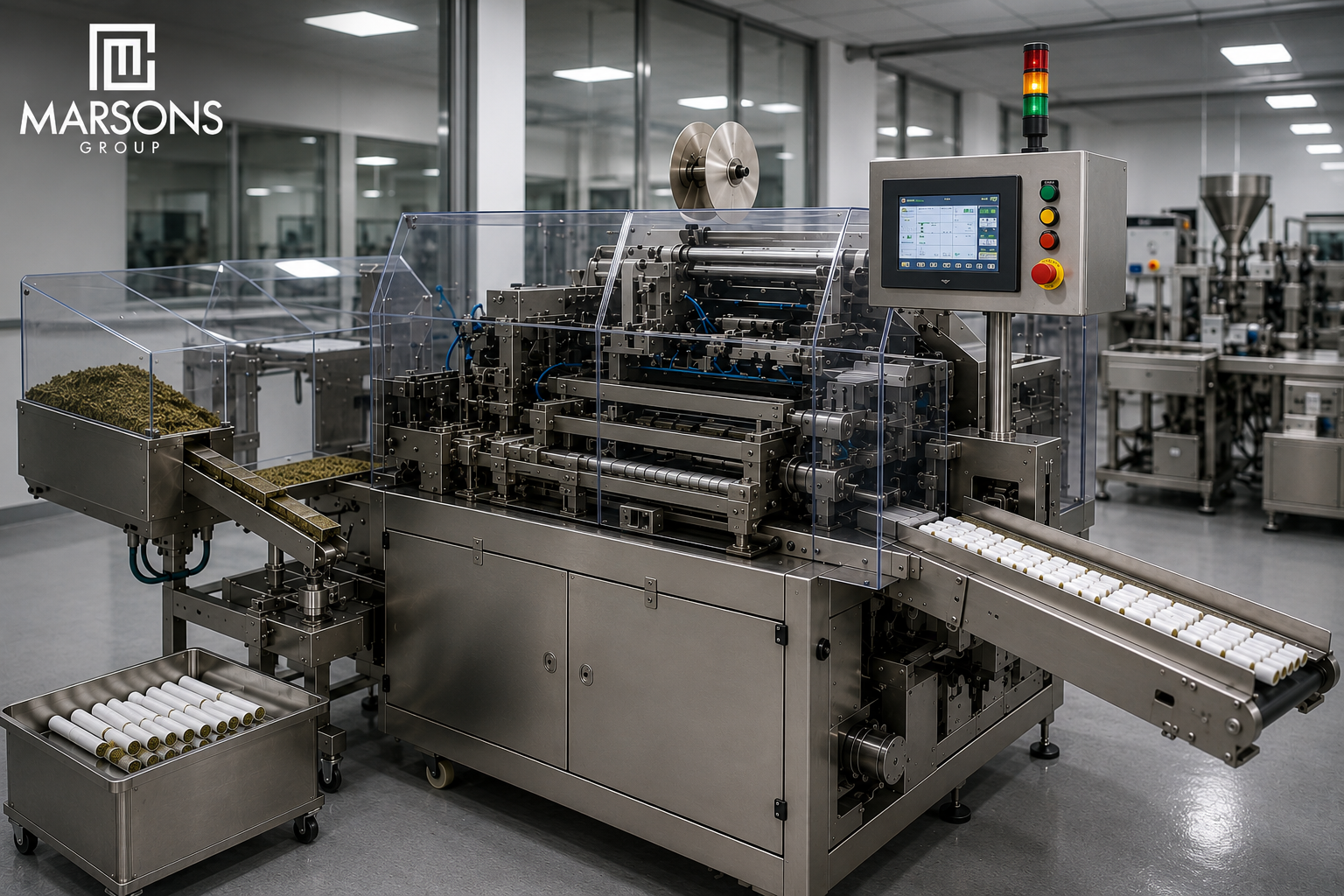
A Cannabis Cigarette Packing Machine automates the filling, compacting, and closing stages of pre-roll production. Unlike tobacco packing equipment, these systems are engineered specifically to handle cannabis flower, which tends to be stickier, denser, and more resin-heavy than tobacco. Standard automated cigarette machines aren’t built for this kind of material, so cannabis-specific equipment uses different feeding mechanisms, tamping pressure, and cone-handling systems to avoid clogging and product loss.
These machines range from compact tabletop units suited to small craft producers to full industrial lines capable of finishing tens of thousands of joints per shift. Regardless of scale, the goal is the same: replace inconsistent manual rolling with a repeatable process that delivers uniform weight, shape, and burn quality every time.
How Cannabis Cigarette Making Machines Work
Most Cannabis Cigarette Making Machines follow a similar production sequence, even if the exact mechanics vary by manufacturer. Ground flower is loaded into a hopper or tray system, then distributed into pre-loaded cones or papers using centrifugal force, vibration, or mechanical compaction. Some systems can pack over a hundred cones in under 20 seconds using centrifugal filling alone.
After filling, inline weight verification checks each unit against a target tolerance, often as tight as 0.01 grams, before flagging or rejecting anything outside spec. The final stage is closing, commonly using a “Dutch Crown” twist finish that seals the tip. High-end systems can complete this closing step at a rate of several thousand joints per hour. Many machines are modular, meaning producers can add or remove stages like grinding, filling, and closing depending on their production volume and budget.
Common Challenges in Cigarette Production and How Machines Solve Them
Manual pre-roll production runs into predictable problems: uneven burns, inconsistent weights, product waste from over-packing, and labor costs that climb fast as volume increases. Even experienced rollers introduce variation over the course of a shift, and that inconsistency becomes expensive once you’re producing thousands of units a day.
Our detailed breakdown, Common Challenges in Cigarette Production and How Machines Solve Them, covers this in depth, but the short version is that automation directly targets these pain points. Weight-verification sensors catch out-of-spec units before they reach packaging, reducing wasted flowers. Standardized tamping pressure improves burn consistency across every unit. And because machines don’t get fatigued over an eight-hour shift, output quality stays flat from the first joint to the last, which is something manual teams simply can’t match at scale.
Compliance Considerations for Cannabis Packing Equipment
Compliance isn’t optional in this industry, and your packing equipment needs to support it, not work against it. Every legal cannabis market in the U.S. requires child-resistant packaging as a baseline, built on the federal Poison Prevention Packaging Act framework under 16 CFR 1700. States then layer additional requirements on top, covering opacity, resealability, and mandatory labeling elements like the universal cannabis symbol and THC content disclosures.
The standards are also tightening. Several states, including Minnesota, New York, New Jersey, and Missouri, have moved toward the updated ASTM D3475-2024 protocol, which tests packaging against both children and seniors under stricter success-rate thresholds than the older poison-prevention standard. This means some popular formats, including certain slide-lock pre-roll tubes, may no longer meet requirements in those states. When evaluating a packing line, confirm that your equipment integrates cleanly with certified child-resistant packaging formats, since retrofitting compliance after the fact is far more expensive than planning for it upfront.
Key Features to Look for in a Cannabis Cigarette Machine
Not every Cannabis Cigarette Machine is built the same, so it helps to know which specifications actually matter for your operation. Throughput is the obvious starting point, but raw speed means little without accuracy, so look closely at weight-tolerance specs and reject rates. Flexibility matters too: many facilities run multiple cone sizes, straight-wall tubes, or infused products, and a machine that requires retooling for every format switch will slow you down.
Build quality also deserves attention. Stainless steel construction, accessible cleaning points, and minimal-clog feeding systems reduce downtime, especially when running sticky, high-resin flowers. Finally, consider how well the machine integrates with your existing packaging line, since fill-and-close automation only delivers full value when it connects smoothly to labeling, weighing, and case-packing stages downstream.
Cannabis Cigarette Machine vs. Hemp Cigarette Making Machine
It’s worth understanding how cannabis-specific equipment compares to a hemp cigarette making machine, since the two are often confused but aren’t always interchangeable. Hemp cigarette machines are generally built to handle low-THC, high-CBD biomass, which tends to be less sticky and resin-dense than high-THC cannabis flower. This means hemp-focused equipment can sometimes run at higher speeds with fewer clogging issues, but it may not be calibrated for the denser packing and infused-product handling that many cannabis producers need.
That said, several manufacturers now build cross-compatible systems capable of running both hemp and cannabis material with adjustable settings. If your production spans both categories, it’s worth confirming compatibility directly with the manufacturer rather than assuming a hemp-rated machine will perform identically on cannabis flower, or vice versa.
Top Models and Manufacturers to Know in 2026
The market has matured significantly, with options across every budget tier. Entry-level modular systems, priced from roughly $3,500 for basic filling units up to around $30,000 for combined fill-and-close bundles, have made automation accessible to craft producers who previously relied entirely on manual labor. Mid-tier systems in the $25,000 to $60,000 range typically offer throughput between 4,000 and 4,500 closings per hour, making them a strong fit for growing multi-state operators.
At the enterprise level, fully integrated systems capable of running cones, straight-wall tubes, and blunt wraps on a single platform serve producers closing tens of thousands of joints per day. These systems typically include inline weight verification, automated cone loading, and infused-product handling for facilities supplying multiple dispensaries or acting as co-packers for other brands.
Where to Buy: What to Look for in a Supplier
When sourcing equipment, prioritize suppliers who offer documented compliance support, not just hardware. Ask whether they provide guidance on integrating certified child-resistant packaging, and request references from operators running similar production volumes. Reliable after-sales service matters just as much as the machine itself, since downtime on a packing line directly affects your ability to fulfill dispensary orders on schedule.
Also compare warranty terms, availability of replacement parts, and whether the supplier offers on-site installation and staff training. A lower purchase price isn’t a good deal if it comes with limited support once the machine is running in your facility.
Conclusion
Automated pre-roll production has moved from a luxury for large operators to a practical necessity across the cannabis industry. Whether you’re a craft producer taking your first step into automation or an established brand scaling toward tens of thousands of units a day, choosing the right Cannabis Cigarette Packing Machine can transform your consistency, compliance readiness, and bottom line.
If your production spans hemp-derived products as well, exploring a reliable Hemp Cigarette Making Machine built for both material types is a smart next step toward a more flexible, future-ready production line.