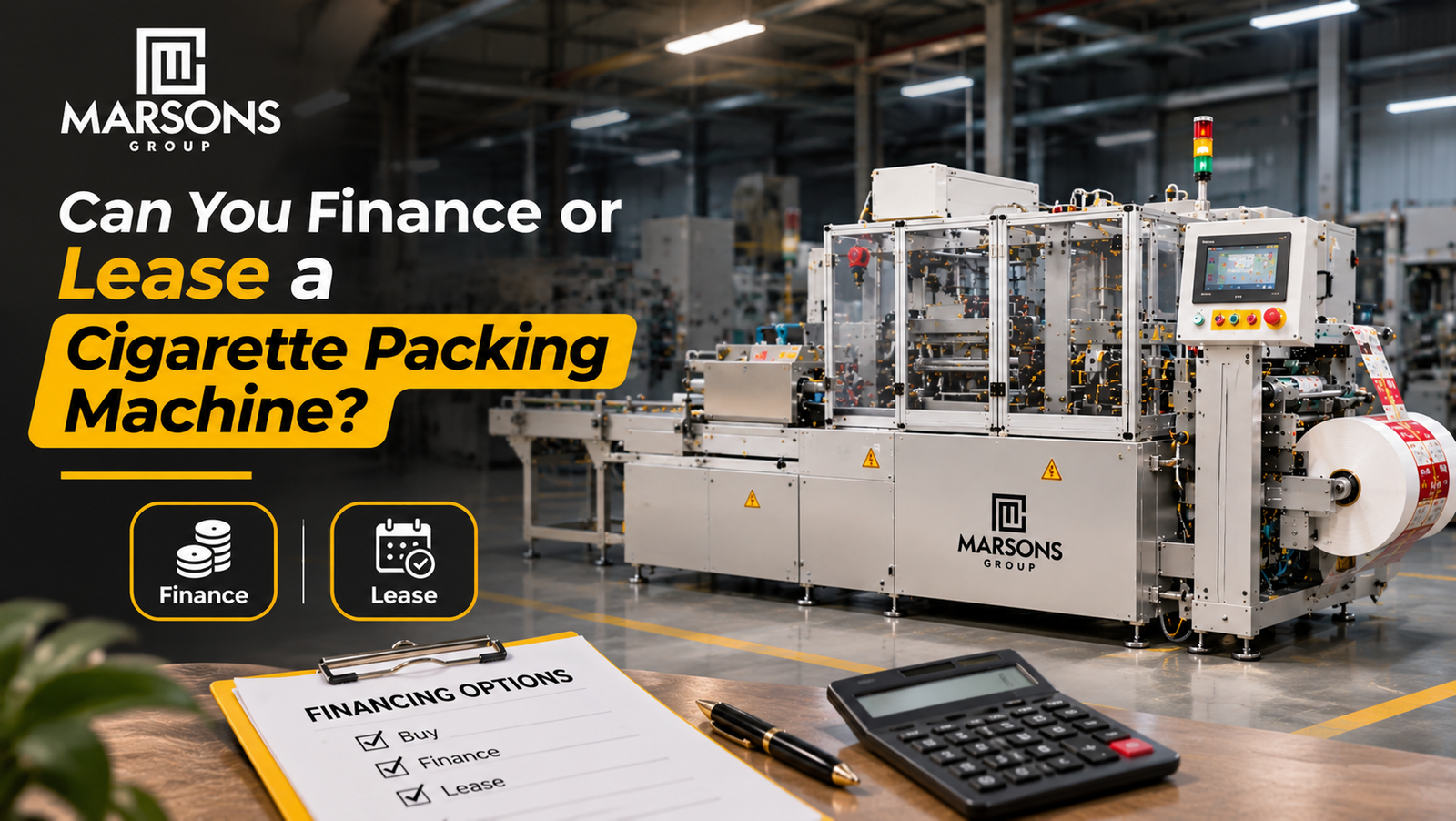
Purchasing industrial packaging equipment requires substantial investment, particularly for manufacturers looking to expand production or introduce automated machinery. Paying the entire amount upfront is not always practical, which raises an important question: can cigarette packing machines be financed or leased? The answer is yes, potentially, although financing availability depends on the lender, business eligibility, and applicable industry restrictions. Understanding cigarette packing machine financing can help manufacturers compare purchasing options and manage financial commitments more effectively. For businesses evaluating machinery specifications, Marsons Group offers Cigarette Packing Machines for different manufacturing requirements. This guide explains available financing structures, ownership considerations, potential costs, and what businesses should assess before entering an equipment financing agreement.
What Is Cigarette Packing Machine Financing and How Does It Work?
Cigarette packing machine financing allows eligible manufacturers to acquire equipment without necessarily paying the complete purchase price immediately. Instead, a financial institution or leasing provider supplies funding under an agreement requiring scheduled payments. Depending on the arrangement, the business may own the equipment from the beginning or receive the right to use it during a specified period. Financing terms can include deposits, interest, security requirements, and contractual restrictions. However, tobacco manufacturing creates an additional consideration because some financial institutions exclude tobacco related activities from their lending policies. Businesses should therefore confirm industry eligibility before applying. Understanding the repayment structure and total financial obligation is essential when evaluating financing against an outright purchase.
What Financing Options Are Available for Cigarette Packing Machines?
Manufacturers may encounter several financing arrangements when exploring industrial equipment purchases. Equipment loans provide funding for machinery acquisition, with repayment made according to agreed terms. Leasing arrangements allow businesses to use equipment over a specified period while the leasing provider generally retains legal ownership. Hire purchase agreements typically involve instalment payments, with ownership transferring after the contractual conditions are satisfied. Each option has different implications for equipment control, payment obligations, and end of term arrangements. Availability also depends on the jurisdiction and lender’s eligibility requirements. Businesses considering leasing tobacco machinery should compare these structures carefully and confirm whether their manufacturing activities qualify under the financing provider’s policies.
Equipment Leasing vs Equipment Financing: What’s the Difference?
The main difference between leasing and financing concerns ownership and contractual responsibilities. With a conventional equipment loan, the business purchases the machine using borrowed funds and repays the lender over time. The equipment may serve as security for the loan. Under a lease, the financing provider generally owns the asset and grants the business the right to use it according to the agreement. Some leases include purchase options, while others provide for equipment return or renewal. Maintenance, insurance, and repair responsibilities may also vary. Buyers should review the complete contract rather than relying only on terms such as finance lease or operating lease. Understanding these differences helps businesses avoid unexpected obligations.
What Are the Benefits of Leasing Tobacco Machinery?
One potential advantage of leasing is that it allows businesses to retain more working capital instead of committing a large amount to an immediate equipment purchase. Available funds can then support other operational requirements, including installation, employee training, maintenance, and production expenses. Scheduled payments may also help manufacturers forecast cash flow over the lease period. However, these benefits depend on the agreement’s actual financial conditions. Leasing can involve additional charges, insurance obligations, and restrictions on equipment modifications or early termination. It may also cost more than purchasing the machine outright over the same period. Manufacturers should evaluate payment flexibility alongside the total contractual commitment before selecting a leasing arrangement.
When Does Buying a Cigarette Packing Machine Make More Financial Sense?
Purchasing machinery outright may be practical when a manufacturer has sufficient capital and expects to operate the equipment for an extended period. Direct ownership eliminates recurring loan or lease payments, although maintenance, utilities, and repair expenses remain. It may also provide greater flexibility regarding equipment modifications and eventual resale, subject to applicable restrictions. Financing can be attractive when preserving cash is more important than minimizing financing charges. However, the decision should reflect expected machine utilization, financial reserves, and long term business requirements. A manufacturer should compare outright purchase costs with total financing payments over the same period. The lowest monthly payment does not necessarily represent the most economical equipment investment.
Understanding CAPEX vs OPEX in Packaging Equipment Investments
Capital expenditure, or CAPEX, generally refers to money invested in long term business assets. Operating expenditure, or OPEX, relates to expenses associated with ongoing business activities. Understanding CAPEX vs OPEX in packaging investments is useful when comparing machinery purchases and leasing arrangements. However, businesses should not assume that leasing automatically converts the complete equipment investment into an operating expense. Under IFRS 16, lessees generally recognize a right of use asset and corresponding lease liability for most leases, subject to specified exemptions. The accounting treatment therefore differs from a simple monthly expense calculation. Manufacturers should distinguish cash flow benefits from financial reporting requirements and obtain qualified accounting advice before deciding how a particular arrangement affects their statements.
What Factors Affect Cigarette Packing Machine Financing Eligibility?
Financing providers generally evaluate whether a business can meet its repayment obligations and whether the proposed equipment provides suitable security. Important considerations may include financial statements, credit history, cash flow, existing liabilities, and the machinery’s purchase value. Lenders may also examine operating history, equipment condition, and expected useful life. For cigarette manufacturers, industry restrictions can be especially important. Some financial institutions maintain policies excluding tobacco production or trade from their financing activities, regardless of the applicant’s financial position. A legally operating manufacturer is therefore not automatically eligible for every industrial equipment loan. Businesses should verify sector eligibility and documentation requirements before spending resources on a detailed application.
How Do Equipment Leasing Companies Evaluate Machinery and Borrowers?
An equipment leasing company may assess both the manufacturer’s financial condition and the commercial value of the machinery being financed. The provider may request an equipment quotation, technical specifications, company registration documents, financial records, and information about existing borrowing commitments. Machinery age, condition, and resale potential can influence the financing terms because specialized industrial equipment may be difficult to value or recover. The provider may also require a deposit, additional security, or insurance coverage. Approval criteria differ between institutions, particularly when financing tobacco manufacturing equipment. Manufacturers should ask whether the provider accepts the relevant industry and equipment category before submitting an application. Clear documentation can help establish the proposed transaction’s financial and technical details.
Interest Rates, Lease Payments, and Hidden Financing Costs
Financing expenses extend beyond the advertised interest rate or monthly lease payment. Depending on the agreement, manufacturers may face arrangement fees, deposits, insurance costs, maintenance obligations, late payment charges, and early termination penalties. Some arrangements also include a final purchase payment or other end of term obligations. These expenses can significantly change the total amount paid for the equipment. Buyers should request a complete payment schedule identifying every mandatory charge. Comparing annual percentage rates or equivalent financing costs may also be useful where appropriate and available. However, different agreements must be assessed using consistent assumptions. Manufacturers should calculate the total cash commitment rather than assume that a smaller monthly payment automatically means lower financing costs.
Can You Finance Used or Refurbished Cigarette Packing Machines?
Financing used or refurbished industrial machinery may be possible through providers willing to accept the equipment’s condition and estimated value. However, eligibility and financing terms can differ from those available for new machines. Lenders may consider the equipment’s age, maintenance history, refurbishment quality, remaining useful life, and potential resale value. Older machinery can create additional uncertainty when technical documentation or replacement components are difficult to obtain. Manufacturers should request inspection records, refurbishment details, and accurate specifications before discussing financing. A lower purchase price may reduce the amount borrowed, but higher repair expenses could affect the equipment’s overall financial value. Evaluating condition and expected reliability is therefore essential when comparing financing options.
How Does Automation Influence Equipment Financing Decisions?
Automation can affect both the initial cost and expected financial performance of cigarette packing machinery. Equipment incorporating automatic feeding, inspection systems, and production monitoring may require a greater investment than simpler configurations. However, these capabilities can also influence labour requirements, packaging consistency, and operational efficiency. The financial benefit depends on actual production demand, machine reliability, and ongoing maintenance expenses. For additional information about automated packaging equipment, explore The Role of Automation in Cigarette Packing Machines in Modern Manufacturing. Manufacturers should evaluate whether the expected improvements justify the additional investment and financing obligations. A machine can be affordable through monthly payments without necessarily delivering a satisfactory financial return.
Important Questions to Ask Before Financing or Leasing Packaging Machinery
Before signing a financing agreement, manufacturers should confirm whether the provider accepts tobacco related equipment and what documentation is required. They should also ask about the deposit, interest rate, payment schedule, insurance requirements, and any additional contractual fees. Ownership rights and end of term conditions deserve particular attention, especially when the agreement includes purchase options or equipment return obligations. Buyers should clarify who is responsible for maintenance, repairs, and unexpected machine failures. It is equally important to understand whether early repayment or termination involves penalties. Comparing written financing offers alongside the equipment’s total ownership costs helps businesses evaluate affordability, financial exposure, and the practical suitability of each arrangement.
Conclusion:
Cigarette packing machine financing can provide manufacturers with alternatives to paying the complete equipment cost upfront. Equipment loans, leasing, and hire purchase arrangements offer different approaches to ownership, cash flow management, and repayment obligations. However, availability depends on lender policies, and some institutions restrict financing for tobacco manufacturing activities. Businesses should evaluate financing charges, machinery condition, maintenance responsibilities, and total contractual payments before making a decision. Buying outright may offer greater financial value in certain circumstances, while financing can help preserve working capital when suitable terms are available. Ultimately, manufacturers should choose an arrangement that supports realistic production requirements, manageable repayment commitments, and sustainable long term equipment ownership.