Rolling cigarettes by hand, or with a basic injector, works fine until orders start to outgrow your team. Then every hour of manual work costs money, and every uneven cigarette is a possible complaint. A commercial cigarette rolling machine promises steadier quality, higher output and lower labor costs, but it also comes with a real price tag, a learning curve and regulatory duties that a small workshop never had to think about. So is it worth it? This guide looks at the true costs, a simple way to estimate payback, the features that matter and the risks to weigh. If you would like to see what is available while you read, you can browse our range of Cigarette Making Machines.
What a Commercial Cigarette Rolling Machine Actually Does
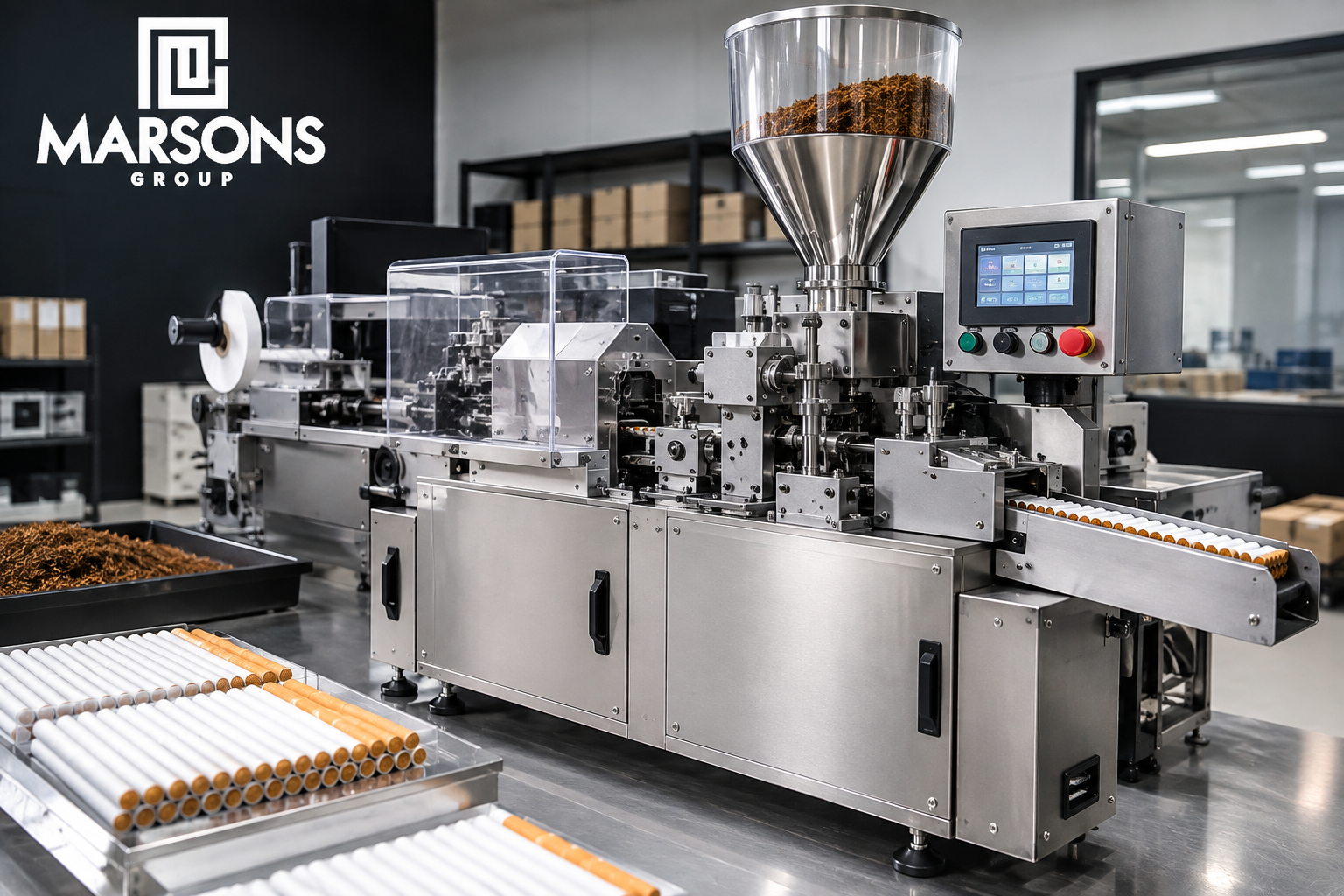
Rolling machines fall into three broad levels: manual, semi-automatic and fully automatic. Manual devices suit hobbyists, while automated systems take over the repetitive work of feeding, compressing and finishing each cigarette. The real benefit is consistency. An automated machine holds size, density and packing steady from the first cigarette to the ten thousandth, which is hard to match by hand over a long shift. Speed varies a lot as well. According to Marsons Group, making machines form finished rods at anything from a few hundred to several thousand cigarettes per minute, and tube-making equipment can reach 5,000 to 7,000 tubes per minute. Which level makes sense depends on how many units you can realistically sell, not on the biggest number in a brochure.
The Real Costs Behind the Purchase
Upfront Price and Installation
Prices vary enormously. Small automatic units rated at around 2,500 cigarettes per hour show up in marketplace listings from roughly USD 1,000 to 2,500, while fully customized industrial lines can run well into six figures. High-speed factory lines are usually priced by quotation, and used equipment tends to sell for a fraction of the new price. Do not stop at the machine itself. Installation, commissioning, electrical work, floor space, spare parts and operator training all belong in the budget. A low headline price can hide a long list of extras, so ask every supplier for a full written quotation and compare them on the same speed, warranty and support terms. Otherwise the numbers will mislead you.
Running Costs, Labor and Maintenance
The purchase price is only the beginning. Ongoing costs include tobacco, paper and filters, energy, spare parts, cleaning and skilled labor. A well-run machine should keep downtime under about 2 percent, hold fill weight to roughly plus or minus 0.1 grams, and get a deep clean every 200 to 500 running hours. With careful maintenance, industrial machines can last 15 to 20 years, and warranties of 6 to 24 months are common. One trained operator can supervise output that would otherwise need several people rolling by hand, and tighter weight control means less tobacco wasted on each cigarette. Over a few years, material savings can add up alongside the labor savings, so work out both before you decide.
How to Calculate Your Return on Investment
There is no universal payback period, because it depends on your volume, labor costs and margins. The simplest method is to divide the total installed cost of the machine by the monthly net gain it creates. That gain is the labor you no longer pay for, plus the tobacco you save through better weight control, plus the profit on extra units you can now sell. As an illustration only, a machine costing USD 30,000 installed that saves USD 2,500 a month across labor and material would pay for itself in 12 months. It also helps to compare total cost of ownership over three years or more, so that maintenance, spare parts and energy are counted honestly instead of ignored.
Industrial Cigarette Rolling Machine vs Semi-Automatic Options
Semi-automatic machines suit small businesses, local distributors and custom brands with moderate demand. They cost less and are simpler to run, but output still depends on an operator feeding, loading and finishing each batch. Producers looking at a cigarette rolling machine industrial in scale are usually buying for continuous shifts and steady output against steady orders, which is why medium and large manufacturers choose this route. If your sales are growing but not yet certain, a modular or entry-level automatic unit lets you scale without overspending. Whichever you pick, match capacity to demand you can prove today, not demand you hope for next year. An oversized machine sitting idle wastes capital just as surely as an undersized one wastes orders.
Features to Look For in a Rolling Machine for Factories
Speed gets the headlines, but control is what protects your margins. Look for real-time weight and density monitoring, automated filter attachment and integrated inspection that rejects faulty cigarettes before they reach packing. Touchscreen controls with automatic error detection reduce operator dependency and make faults easier to trace. Check compatibility with your paper sizes, filters and density settings, and ask about modular upgrades so the machine can grow with your range. Just as important, confirm that the output rate and cigarette format match your packing line, because a fast maker feeding a slower packer only moves the bottleneck down the line. Even the most automated setup still needs trained people for supervision, quality checks and preventive maintenance, so plan training from day one.
Risks and Compliance to Consider Before You Buy
A machine is only useful if you are allowed to run it and sell what it makes. Tobacco is one of the most heavily regulated industries, and setting up a factory usually means manufacturing licenses, tax registration and local permits, with approvals that can take months. In the United States, manufacturers need a federal permit, must keep detailed records and file monthly reports. The European Union requires unique identification codes on tobacco products under its track and trace system. Rules differ from country to country, so check what applies where you plan to sell. Beyond regulation, allow for downtime, shifting demand and the chance that a machine outlasts the market it was bought for.
Choosing the Right Manufacturer and Support Package
The supplier matters almost as much as the machine. Production is a chain of steps, from leaf preparation and cutting to making and packing, and a good manufacturer helps you plan the whole line instead of selling one machine in isolation. If you want a deeper look at how those stages fit together, the Cigarette Machine Manufacturer Guide for Modern Tobacco Production is worth a read before you talk to suppliers. When you shortlist, ask about installation, commissioning, operator training, spare parts and support after the sale. For used or rebuilt machines, request running hours, service history and a video of the machine at full speed. Marsons Group also cautions that unusually low quotes often signal cut corners, and that skipping a trial run is a common mistake.
Final Thoughts
So, is a commercial cigarette rolling machine worth the investment? For many growing producers, yes, but only when the numbers back it up. If your volume is steady, your labor costs are meaningful and consistency matters to your customers, automation usually pays for itself through less waste, higher output and fewer complaints. If demand is small or uncertain, a simpler machine or a phased upgrade is the safer path. Either way, do the homework. Define your volume, build a realistic payback estimate, check local compliance and test the machine on your own tobacco before you sign. Done properly, the purchase becomes a long-term asset rather than an expensive experiment.