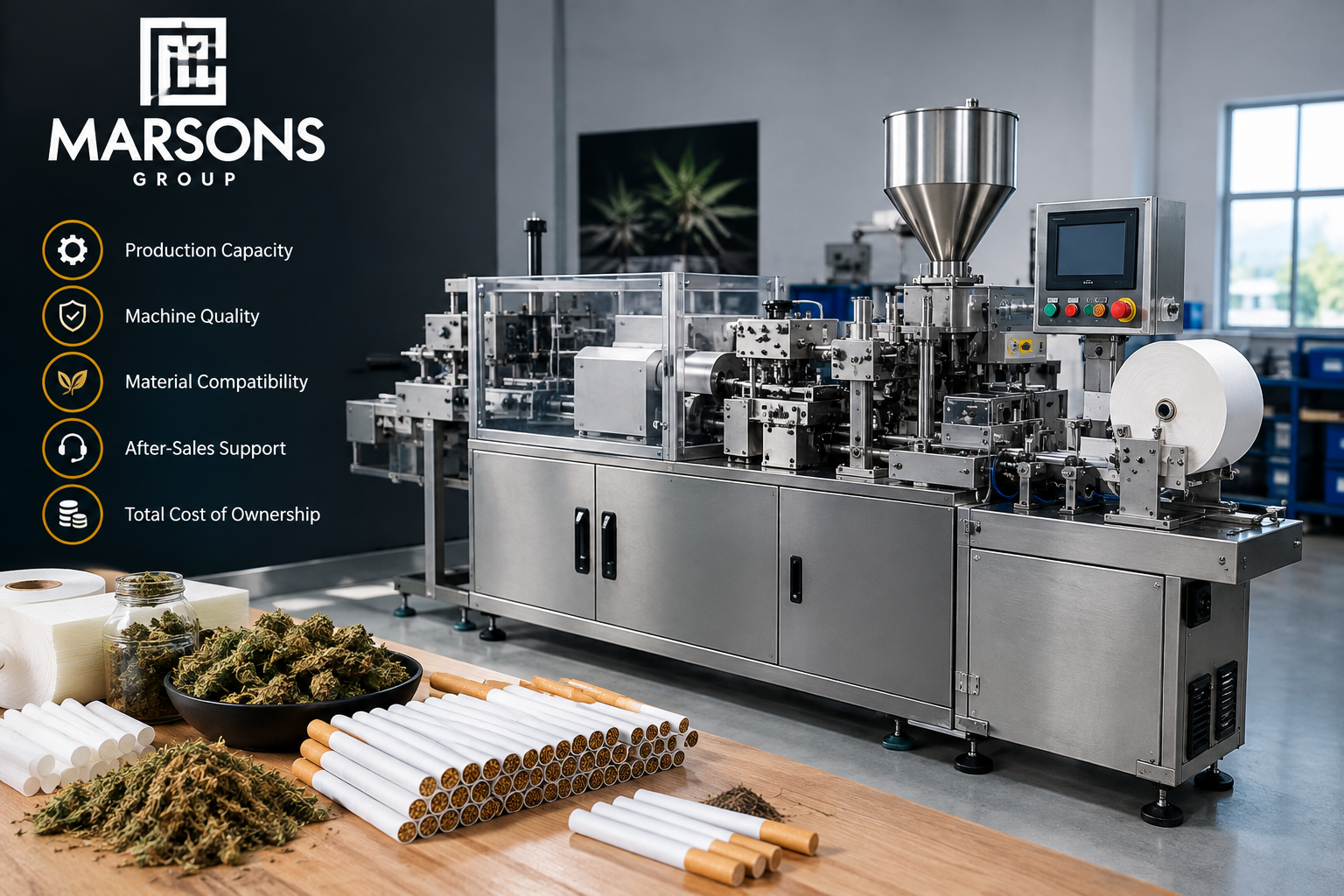
Demand for hemp smoking products keeps growing, and manufacturers are under pressure to deliver consistent quality at a competitive cost. The global hemp market was valued at roughly USD 7.1 billion in 2025 and is projected to reach USD 23.5 billion by 2034, according to IMARC Group. In a market moving that fast, the machine on your production floor becomes one of the biggest factors in product quality, waste and profit. Many buyers compare only price and speed, then find costly gaps months later. This guide covers what really matters when choosing hemp processing equipment, from output and filling precision to compliance and after-sales support. If you would rather start by looking at real options, our Hemp Cigarette Making Machine range is a good place to begin.
Why the Right Hemp Processing Equipment Matters
Hemp is a fragile, fibrous material, and it behaves very differently from tobacco. Stems, seeds and uneven particle sizes can jam a poorly matched machine, while inconsistent packing produces joints that burn unevenly and vary in weight from one unit to the next. The right hemp processing equipment reduces that risk by controlling how material is cleaned, filled and closed, which protects both your brand reputation and your margins. Waste matters as much as speed. Better industrial machines are designed to separate heavy items such as stems and seeds and to shape each roll with high precision. That precision counts because scrap adds up quickly across thousands of units, and a machine that wastes a small share of material on every run quietly eats into profit long before anyone notices.
Key Hemp Cigarette Making Machine Specifications to Check
Production Capacity and Output Speed
Start with output, but read the numbers carefully. Most hemp cigarette making machine specifications are quoted in units per minute, and the range is huge. Mid-range automatic makers suited to longer runs of a single product typically reach around 150 pre-rolls per minute and often include online weight control, while industrial lines built for shredded hemp blends and recon paper are rated at up to 5,000 per minute. Some compact designs have few parts, so they can be cleaned and converted quickly when you change products often. Marsons Group notes that high-end cone-filling systems can pack over a hundred cones in under 20 seconds using centrifugal filling. Treat every figure as a manufacturer’s claim and ask for a live demonstration on your own material. If you only make a few hundred pre-rolls a week, a compact semi-automatic filler may be all you need.
Material Compatibility and Filling Precision
Not every machine handles every material. Hemp biomass is generally less sticky and resin-dense than high-THC cannabis flower, so hemp-focused equipment can often run faster with fewer clogs. The trade-off is that it may not be calibrated for the denser packing some cannabis producers need. If your range could stretch into both categories, confirm cross-compatibility with the manufacturer instead of assuming it. Precision matters just as much as compatibility. Look for inline weight verification, which checks each unit against a target tolerance, sometimes as tight as 0.01 grams, and rejects anything outside the specification. Ask how the hopper deals with clumps too, since vibration or shaking mechanisms help break them apart and keep material flowing evenly. Consistent flow is what keeps every joint in a batch close to the same weight.
Build Quality and Automation Level
Automation determines how many people you need and how repeatable your results are. Fully automatic lines fill, tamp and close with minimal handling, while semi-automatic units depend more on operators. Many machines are modular, so you can add or remove stages such as grinding, filling and closing as volume or budget changes, which protects you from outgrowing your first purchase. Check whether the equipment connects with your existing production line, packaging and factory management systems, because a fast machine that cannot talk to the rest of your workflow creates its own bottleneck. Build quality deserves attention as well. Ask how easily parts can be reached for cleaning, how many components wear out, and how long a changeover takes. Downtime quietly erodes output more than a slightly lower rated speed ever will.
Industrial Hemp Equipment: Durability, Safety and Compliance
Industrial hemp equipment has to survive long shifts and meet safety expectations in the country where you sell. For parts that touch your material, stainless steel is the usual choice, following food-processing practice: grade 304 is cost-effective for general food contact, while 316 suits more corrosive environments. Ask for certifications, but read them critically. A CE mark is largely a manufacturer’s self-declaration, whereas ISO 9001 certifies a quality management system through third-party audits, so request the declaration of conformity, the list of standards applied and certificate numbers instead of accepting a logo. If you plan to sell in Europe, note that the Machinery Regulation (EU) 2023/1230 replaces Directive 2006/42/EC on 20 January 2027. The rules for hemp itself are shifting too. In the United States, the federal definition of hemp moves to a total THC standard of 0.3% by dry weight, including THCA, with most changes delayed to 11 December 2026. Rules differ by country and state, so confirm what applies to your product before you buy.
Where to Find Hemp Processing Equipment for Sale
Once you know your specifications, the search for hemp processing equipment for sale becomes much more focused, whether you buy direct from a manufacturer, through a distributor or from a used-equipment dealer. Used machines can offer real capital savings and faster availability, but they call for closer scrutiny of wear, service history and parts supply. Whichever channel you choose, treat the sales conversation as a preview of the relationship. Ask for reference customers who have run the machine for at least two years, and actually speak to them. Request a trial run using your own hemp blend, because moisture, particle size and stem content all change performance. Be cautious if a supplier dodges questions about spare part pricing or lead times. Claims such as CE, FDA or ISO should be backed by documents you can verify, not just a logo on a brochure.
Budget, After Sales Support and Long-Term Value
Sticker price tells only part of the story. According to Marsons Group, fully automated enterprise systems can exceed six figures, and most operators report a return on investment for purpose-built pre-roll equipment within roughly six to eighteen months, depending on volume and the labor saved. Adapting a traditional cigarette machine rarely saves money once modifications, slower throughput and extra maintenance are counted. If you want a closer look at how these machines work before you commit, Cannabis Cigarette Machine: How It Works & Why You Need One is a useful read. Build a five-year cost model that includes installation, training, maintenance and downtime. Then examine the support package: response time for service requests, how long spare parts stay in stock after a model is discontinued, whether training and remote help are included, and what the warranty covers. A 12-month warranty after commissioning is common, though wear parts are usually excluded, so order critical spares with the machine.
Final Thoughts
Choosing the right machine comes down to matching your real production needs with proven specifications, verified compliance and dependable support. Define your volume and material first, then compare capacity, filling precision, automation and build quality side by side. Check certifications and local regulations, test the machine on your own hemp, and work out the full cost of ownership before you sign anything. Buyers who follow that discipline tend to find that hemp processing equipment stops being a risky expense and becomes a long-term asset that protects both the brand and the margins. Take your time, ask the awkward questions, and choose the supplier who answers them clearly.