
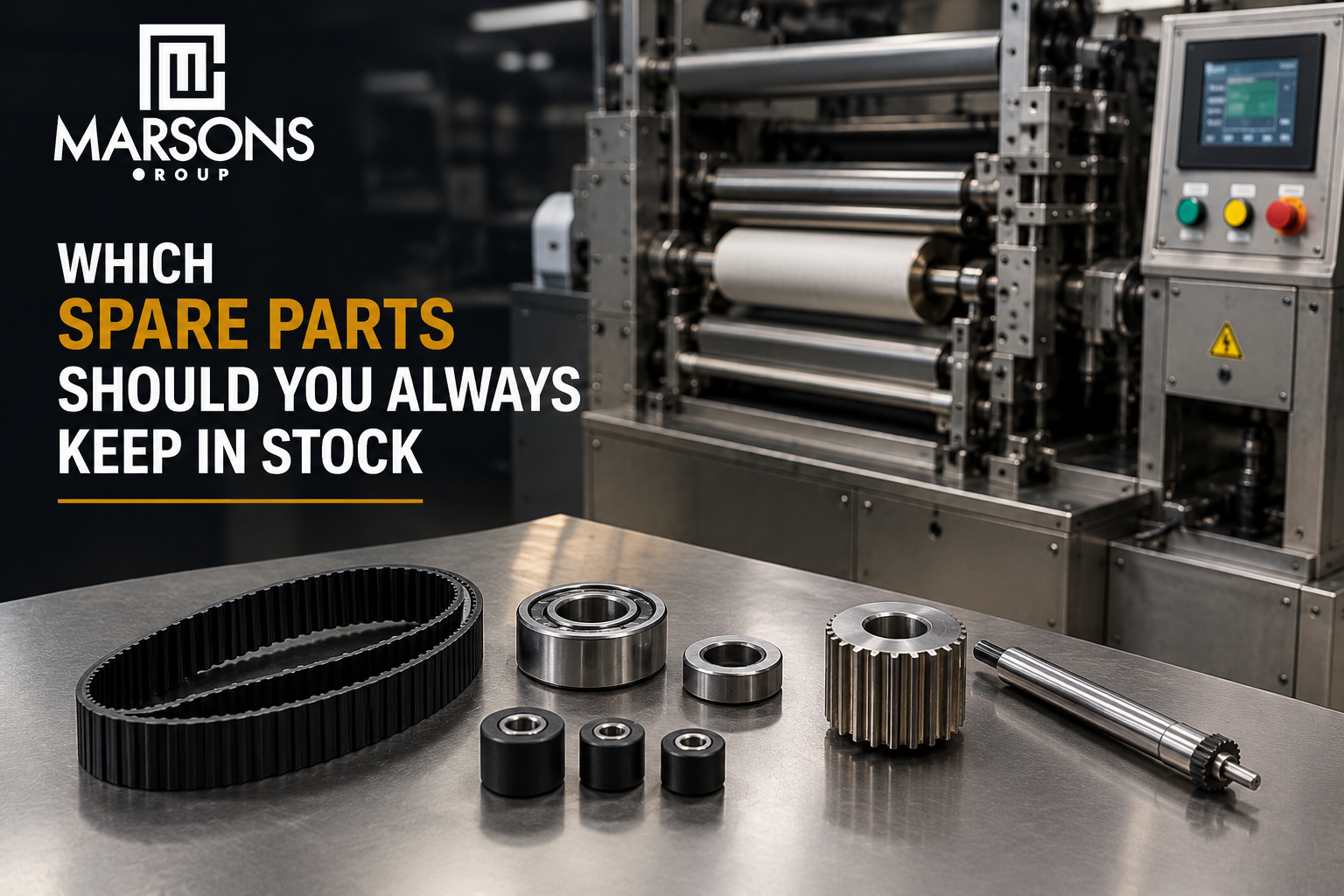
Every tobacco manufacturer eventually faces the same question during a production halt: why didn’t we have that part on hand? A single worn garniture tape or a failed sensor can bring an entire line to a standstill, and the cost of that downtime often far exceeds the price of the part itself. Getting spare parts inventory management right is not just a warehousing task. It is a decision that directly protects output, revenue, and customer commitments. For manufacturers looking to strengthen their supply of Tobacco Machinery Spare Parts, understanding which components genuinely need to sit on the shelf is the first step.
This guide walks through how to identify the parts your facility should always stock, how to size that inventory correctly, and how to avoid the common mistakes that either drain cash on unnecessary stock or leave critical lines exposed.
Why Spare Parts Inventory Management Matters in Tobacco Manufacturing
Cigarette-making and packing machines run at extremely high speeds, often producing hundreds of packs per minute. That speed means components wear quickly, and when one fails, the entire line stops rather than slowing down gradually. Industry surveys have found that roughly three out of four manufacturers have experienced a shutdown caused specifically by a missing spare part, which underlines just how common and costly this problem is.
Beyond the immediate loss of output, unplanned downtime creates ripple effects. Labor costs continue while machines sit idle, delivery schedules slip, and rush orders for replacement parts often come with premium pricing and expedited shipping fees. For tobacco manufacturers operating on tight margins and strict delivery contracts, a disciplined approach to spare parts is one of the most effective ways to protect both production continuity and profitability.
Understanding Critical vs. Non-Critical Spare Parts
Not every component deserves a permanent spot in your storeroom. The starting point for any effective system is criticality analysis, which ranks parts by how severely their failure would impact production. A part that would halt the entire line, has a long lead time, or comes from a single specialized supplier deserves a high priority. A part that is cheap, widely available locally, or rarely fails can usually be ordered as needed instead.
Many facilities use ABC or XYZ classification to formalize this process. ABC ranks parts by consumption value and importance, while XYZ factors in how predictable demand is for each item. Combining the two gives a clearer picture of where to invest inventory dollars. The goal is not to stock everything, but to stock the right things in the right quantities, based on actual failure impact rather than guesswork.
Critical Spare Parts Inventory for Tobacco Factories: What to Prioritize
For most tobacco production lines, certain components consistently top the priority list. On cigarette-making machines, garniture tapes are essential since they shape and wrap the cigarette rod during production, and any degradation directly affects product quality. Filter rod cutters, suction rollers, and paper feed belts also see constant mechanical stress and should always be available in reserve.
On the packing side, folding plates, packaging films, sealing components, and loose end detectors are frequent wear items that can stop a packer mid-run if unavailable. Conveyor belts, sensors, and PLC control components deserve attention too, since electrical faults can be just as disruptive as mechanical ones. Building a critical spare parts inventory tobacco factory operations can rely on means mapping these components against your specific machine models, whether Hauni, Molins, Protos, GD, or SASIB, since compatibility varies significantly between brands.
Building Safety Stock for Cigarette Machine Parts
Once critical parts are identified, the next challenge is deciding how many units to keep on hand. This is where safety stock comes in. Safety stock is the buffer quantity held above expected demand to protect against lead time delays or unexpected usage spikes. A simple starting formula is: safety stock equals maximum daily usage multiplied by maximum lead time, minus average daily usage multiplied by average lead time.
For safety stock cigarette machine parts, lead time variability matters enormously, since many components are imported from specialized manufacturers overseas and can take weeks to arrive. Facilities with unreliable or distant suppliers should lean toward higher safety stock levels, while those with local or multiple qualified suppliers can operate with a leaner buffer. Reviewing historical failure data and supplier performance every few months helps keep these levels accurate rather than static.
Why Part Quality Matters as Much as Quantity
Sourcing decisions matter just as much as stock levels. Genuine or precision-engineered parts consistently outperform generic alternatives in wear resistance, dimensional accuracy, and consistency at high operating speeds. A garniture tape or filter rod cutter manufactured to tight tolerances will last longer and produce more consistent output than a cheaper substitute, even though the upfront cost may be higher.
Quality also affects compliance. Components that contact tobacco or packaging materials often need to meet material safety and hygiene standards, and cutting corners here can create regulatory risk alongside mechanical risk. Choosing suppliers with proven quality management systems and documented performance data reduces both unplanned downtime and the chance of product quality issues reaching the market.
How to Minimize Downtime with Spare Parts Planning
Strong inventory levels only solve half the problem. The other half is planning proactively rather than reacting to failures. Predictive maintenance, using sensors and performance data to flag wear before it causes a breakdown, allows teams to schedule replacements during planned downtime instead of losing production unexpectedly.
Forecasting also plays a role. Reviewing usage trends, machine age, and seasonal production demands helps refine reorder points over time rather than relying on static assumptions. Some manufacturers also explore vendor-managed inventory arrangements, where suppliers monitor stock levels and trigger replenishment automatically. Combining these approaches is one of the most reliable ways to minimize downtime with spare parts planning, shifting the operation from reactive firefighting to controlled, predictable maintenance.
Common Mistakes in Spare Parts Inventory Management
Even experienced operations fall into familiar traps. Overstocking slow-moving or obsolete parts ties up capital and storage space without reducing actual risk. Understocking critical wear items, on the other hand, is the more damaging mistake, since it directly causes the downtime the whole system is meant to prevent.
Poor tracking is another recurring issue. Without accurate records of what is in stock, where it is located, and how quickly it moves, teams often duplicate orders or discover shortages only when a machine is already down. Weak communication between maintenance, procurement, and operations teams compounds these problems further, since decisions about what to stock are often made in isolation rather than based on shared failure and usage data.
Best Practices for Organizing a Spare Parts Inventory System
A well-organized system starts with clear categorization by criticality, machine type, and supplier. Assigning barcodes or internal SKUs to every part, and logging them in a digital tracking system or CMMS, dramatically improves accuracy and reduces the time spent searching during an emergency. Maintaining an up-to-date bill of materials for each machine also ensures nothing critical is overlooked when planning stock levels.
Regular physical audits catch discrepancies before they become costly surprises, while strong supplier relationships ensure faster turnaround when urgent orders do arise. None of these practices need to be complicated. Consistency and discipline matter more than sophistication, and even a modest spreadsheet system, applied rigorously, outperforms an expensive platform used inconsistently.
Conclusion
Deciding which spare parts to always keep in stock comes down to understanding criticality, calculating safety stock accurately, and sourcing components that hold up under demanding production conditions. Tobacco manufacturers who invest in this discipline consistently see fewer unplanned stoppages and steadier output. For a deeper look at why part quality is just as important as quantity, The Importance of High-Quality Tobacco Machinery Spare Parts in Production Lines is worth reviewing as you build out your own inventory strategy.