
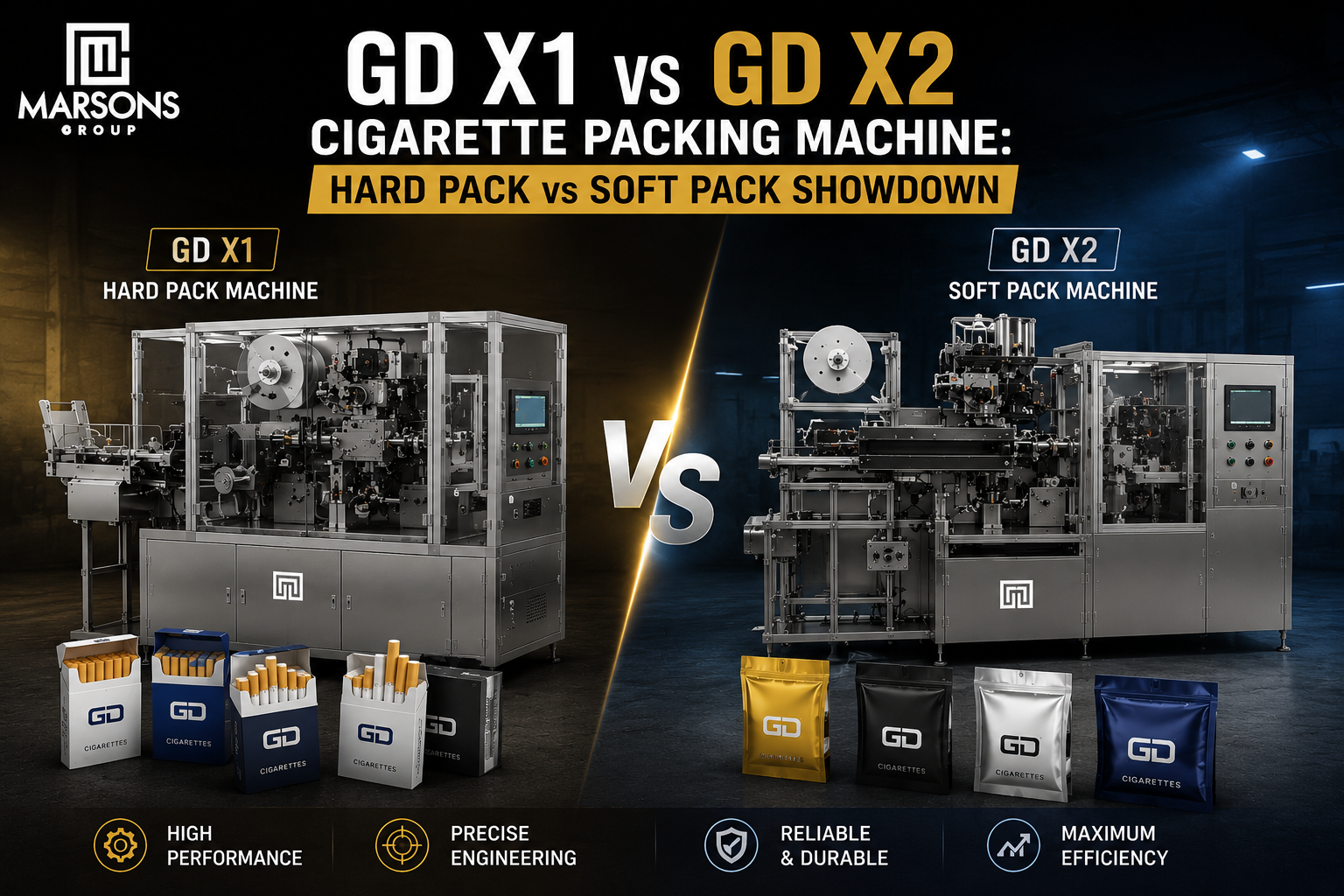
Walk into any serious cigarette production facility and you will find people with strong opinions about pack format. Some swear by hard box. Others have been running soft pack for decades and see no reason to change. The debate is older than most of the machines involved in it. But when it comes to actually choosing equipment, the conversation gets more practical fast. The GD X1 cigarette machine and the GD X2 are two of the more recognized names in this space, and they represent opposite ends of the hard pack versus soft pack divide. This blog breaks down what each machine actually does, where it fits, and how to figure out which one belongs on your production floor.
Starting With the Basics
Before getting into the comparison, it helps to be clear on what each machine is built for. The GD X1 soft packing machine is designed for soft cup format cigarettes. This is the classic squeeze pack that has been a staple in many markets for generations. The machine takes the cigarette group, applies the inner foil, wraps the outer paper cup around it, and seals everything into the finished soft pack format. It is a format that still commands serious market share in parts of Africa, Asia, and Eastern Europe, which is why demand for the GD X1 cigarette machine has not gone anywhere despite the global shift toward hard box.
The GD X2, on the other hand, is a hard pack packing machine. It produces the rigid flip-top box that has become the dominant format in most Western markets and is growing steadily across emerging markets too. The machine handles the full hard box sequence, inner foil wrapping, outer carton application, edge folding, tax stamp placement, and overwrap sealing, all in one automated process.
So at the most basic level, the choice between these two machines is not really about which one is better. It is about which pack format your market demands.
Pack Format and Market Demand
This is where most manufacturers need to start the decision-making process, not with machine specs, but with what their customers are actually buying.
Hard box has been gaining ground globally for a while now. Regulatory pressure in many markets has pushed manufacturers toward formats that display health warnings more prominently, and hard box tends to accommodate that better. Premium and mid-range brands have also shifted toward hard box because the format conveys a higher perceived quality to the consumer. If your production is aimed at these markets, a hard pack packing machine is the practical choice.
Soft pack, however, is far from dead. In price-sensitive markets where manufacturing cost per unit matters enormously, soft cup format is still very much alive. The packaging material cost is lower, the production process is slightly simpler, and there is a consumer base that actively prefers the format. For manufacturers producing value brands for markets where soft pack still dominates, the GD X1 soft packing machine remains a relevant and practical piece of equipment.
The honest answer is that some facilities need both. If you are producing for multiple markets or multiple brand tiers, having dedicated lines for each format is not unusual. In that scenario the question is not X1 or X2, it is which one comes first based on where your current production gap is.
Output and Speed
Both machines are built for commercial scale production, but the speed profiles are worth understanding before you buy. The GD X1 cigarette machine runs at a competitive output rate for soft pack production. Soft pack format involves fewer folding and forming steps than hard box, which means the mechanical sequence is slightly less complex. This generally allows for consistent high-speed operation with fewer interruptions once the machine is properly set up and running.
The GD X2 handles a more involved mechanical sequence because of the nature of hard box production. Carton forming, edge folding, and overwrap sealing each add steps to the process. The machine is built to handle these at speed, but the complexity of the sequence means there are more points in the process where calibration and maintenance matter.
For both machines, the real-world output rate you get depends heavily on the condition of the specific unit, how well it has been maintained, and how experienced your operators are with the format. The spec sheet number is a ceiling, not a guarantee.
Mechanical Considerations
Both the GD X1 and GD X2 have been in commercial use long enough that experienced tobacco machinery technicians are familiar with them. That is genuinely useful information for any production manager thinking about what happens when something needs attention on the floor.
Spare parts for both machines are available through established tobacco machinery suppliers. This is one of the advantages of buying equipment with a long track record in the industry. You are not dependent on a single source for components, and the parts market is reasonably well supplied compared to newer or less common models.
If you are evaluating a GD X 2 packing machine for sale as a used or rebuilt unit, the areas to focus on are the carton forming section, the overwrap unit, and the gluing system. These are the components that see the most wear during hard box production. For a used GD X1, the foil application mechanism and the cup-forming section deserve close attention. Both areas handle repetitive, high-speed motion and are where wear shows up first.
Integration With Your Production Line
Neither machine operates in isolation. The output of your making machine needs to match the input capacity of whichever packing machine you choose, and the output of the packing machine needs to feed smoothly into your carton line if you have one.
For manufacturers setting up a new line from scratch, this is a conversation worth having with your machinery supplier before any purchase is finalized. The right supplier will help you think through line speed compatibility, conveyor interface, and format changeover requirements as part of the purchasing process, not as an afterthought once the machine is already on your floor.
For a full look at what is currently available in packing equipment across both formats, the cigarette packing machines page on the Marsons Group website is worth going through. It covers the current inventory with specs and gives you a useful reference point when comparing options across suppliers.
Where Marsons Group Fits In?
Marsons Group has been supplying tobacco machinery internationally since the 1960s. They carry both hard pack and soft pack equipment and work with manufacturers across a wide range of markets and production scales.
What makes the difference with Marsons Group is not just the equipment they supply. It is the support structure behind it. Installation assistance, technical support, and spare parts supply are all part of how they work with clients after the sale. For manufacturers who have dealt with suppliers who disappear once payment clears, that ongoing commitment is worth paying attention to.
Whether you are looking at a GD X2 cigarette machine for a new hard box line or evaluating a GD X1 soft packing machine to serve a market where soft cup still leads, Marsons Group brings the experience and the inventory to help you make the right call.
Conclusion
The GD X1 and GD X2 are both capable machines with solid track records in commercial tobacco production. The choice between them comes down to one thing more than anything else: what your market wants in a pack. Get that right and the rest of the decision follows naturally. To better understand the Role of Automation in Cigarette Packing Machines, it is worth exploring how modern automation continues to improve speed, consistency, and efficiency across tobacco packaging operations. Choose your format based on where your sales are, match the machine condition and supplier support to what your production line actually needs, and you are in a strong position before the machine ever arrives on your floor.