
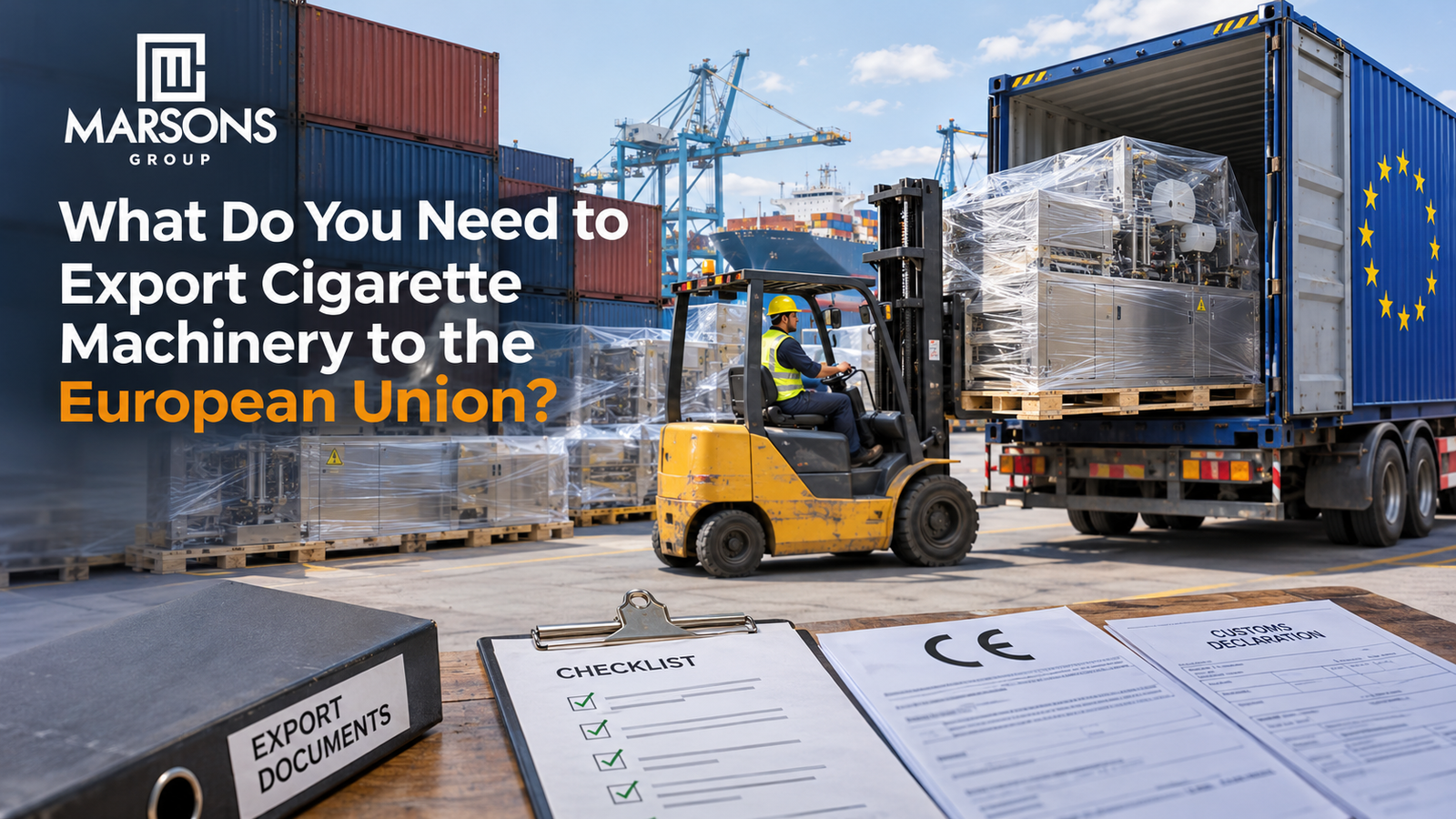
Exporting cigarette manufacturing machinery to the European Union requires more than arranging international shipping and finding a buyer. Industrial equipment entering the EU must satisfy applicable safety regulations, customs requirements, and trade compliance obligations before it can be placed on the market. Businesses planning to export cigarette machinery to EU countries need to understand CE marking, technical documentation, customs classification, and the responsibilities of exporters and importers. These requirements can become particularly important when dealing with refurbished equipment or complex manufacturing systems. For manufacturers exploring international machinery supply and technical assistance, Marsons Group provides installation guidance, equipment setup, and training through Our Services. This guide explains the essential regulatory, technical, and logistical considerations involved in exporting cigarette manufacturing equipment to European markets.
Can You Legally Export Cigarette Manufacturing Machinery to the European Union?
Cigarette manufacturing machinery can generally be imported into the European Union, provided the equipment and transaction comply with applicable regulations. There is no universal EU prohibition on importing machinery simply because it is intended for tobacco production. However, exporters must verify machinery safety requirements, customs obligations, and any relevant trade restrictions before shipping. The importing business must also ensure that equipment satisfies applicable EU product requirements before placing it on the market. This responsibility becomes particularly important when machinery originates outside the European Union. Previously used equipment may also need conformity assessment when entering the EU market for the first time. Exporters should therefore confirm the machine’s regulatory status, intended destination, and importer’s responsibilities before finalizing a commercial agreement.
Understanding EU Machinery Regulations and CE Marking Requirements
CE marking is an important requirement for machinery covered by applicable European product safety legislation. As of November 2026, machinery placed on the EU market generally remains subject to Machinery Directive 2006/42/EC. The newer Machinery Regulation (EU) 2023/1230 becomes applicable on 20 January 2027, introducing updated safety and conformity requirements. Exporters should determine which legislation applies based on when the equipment is placed on the market. Questions about CE marking tobacco machinery should be addressed through a proper conformity assessment rather than purchasing a generic certificate. Manufacturers must identify applicable requirements, assess relevant risks, prepare supporting documentation, and issue the required declaration of conformity. Certain machinery may also be subject to additional EU legislation covering electrical safety or electromagnetic compatibility.
What Technical Documentation Is Required for EU Machinery Compliance?
Technical documentation demonstrates how industrial machinery satisfies applicable EU safety requirements. Depending on the equipment, manufacturers may need to maintain technical drawings, risk assessments, electrical information, safety system descriptions, testing records, and evidence supporting conformity. Operating instructions should explain safe installation, operation, maintenance, and foreseeable risks. Required instructions and safety information must also meet applicable language requirements in the destination EU member state. The manufacturer generally retains the technical file and makes it available to competent authorities when required, rather than automatically shipping the complete file with every machine. However, the appropriate declaration of conformity and required instructions must accompany qualifying equipment. Exporters should also confirm whether the product is complete machinery or partly completed machinery, since the applicable documentation and conformity procedures can differ.
How to Determine the Correct HS Code and Customs Classification
Correct customs classification is essential because it influences import duties, documentation requirements, and possible restrictions. Under the international Harmonized System, heading 8478 generally covers machinery used for preparing or making up tobacco. However, exporters should not assume every machine used in cigarette production falls under the same classification. Complete cigarette making machines, individual components, spare parts, and separate packaging equipment may require different tariff codes. The European Union uses its Combined Nomenclature and TARIC system to identify more detailed classifications and applicable customs measures. Buyers and exporters should verify the correct code before preparing shipping documents. Where classification remains uncertain, an importer may request Binding Tariff Information from the relevant customs authority to obtain a legally binding classification decision.
Essential Shipping and Customs Documents for Exporting Cigarette Machinery
The EU import procedure for cigarette equipment generally requires accurate commercial and transport documentation. Exporters should prepare a commercial invoice identifying the seller, buyer, machinery description, transaction value, and agreed delivery conditions. A packing list should describe the shipment’s contents, dimensions, and weight. Depending on the transport method, the shipment will also require an appropriate bill of lading, air waybill, or other transport document. Origin documentation may be necessary in particular circumstances, including when claiming preferential tariff treatment. The EU importer generally needs an Economic Operators Registration and Identification number, known as an EORI number, to complete customs operations. Supporting compliance documentation should also be available where required. Consistency between invoices, customs declarations, and physical shipments helps reduce avoidable clearance problems.
Understanding EU Import Duties, VAT, and Customs Clearance
Importing cigarette manufacturing machinery into the European Union may involve customs duties, import VAT, and administrative expenses. The applicable customs duty depends on the machinery’s classification, customs value, origin, and relevant trade measures. Import VAT depends on the rules and rates applicable in the destination member state. Consequently, exporters should avoid relying on a single fixed tax percentage for every European shipment. European customs machinery clearance procedures also require accurate declarations and supporting documents before imported goods can be released into the relevant customs procedure. Buyers should clarify who is responsible for customs brokerage, duties, VAT, and destination charges. These responsibilities should be reflected in the sales agreement, helping both parties understand the full financial commitment before shipment.
Export Licences, Trade Restrictions, and Sanctions Screening
International machinery transactions may be subject to export controls, sanctions, or restrictions depending on the countries and parties involved. Exporters should examine the regulations applicable in their own country and verify any restrictions relevant to the destination, buyer, and intended use. Certain sanctions measures can affect tobacco manufacturing equipment, especially transactions involving designated countries or restricted entities. However, such measures should not be interpreted as a general ban on cigarette machinery entering the European Union. A separate export licence is not automatically required for every shipment. The need for authorization depends on the actual transaction and applicable legislation. Proper screening before accepting payment or arranging transportation can help identify legal concerns and prevent shipments from proceeding under incorrect assumptions.
Packaging, Transportation, and Insurance Requirements for Industrial Machinery
Transporting cigarette manufacturing machinery requires suitable packaging and careful handling because equipment may contain sensitive mechanical, electrical, and control components. Depending on its size and configuration, machinery may require protective crating, secure lifting arrangements, moisture protection, and specialized freight services. Exporters using wooden pallets or crates should consider EU requirements based on the ISPM 15 international standard. Qualifying wooden packaging entering from countries outside the EU generally needs appropriate treatment and official markings. Transportation arrangements should also address cargo insurance, loading responsibilities, and delivery conditions. The chosen Incoterms rule helps establish how transport costs and risks are allocated between the parties. Clear arrangements are particularly important when equipment requires dismantling before shipment or specialized handling upon arrival.
Installation, Safety Testing, and After Sales Support in the EU
Successfully delivering machinery does not necessarily mean it is ready for operation. Installation may require appropriate electrical connections, suitable factory infrastructure, safety checks, and commissioning procedures. Exporters and buyers should agree on who will install the equipment, provide operating instructions, and verify that the machinery functions according to its specifications. Additional considerations may include operator training, maintenance documentation, spare parts availability, and technical assistance after delivery. These responsibilities should be established before shipment rather than negotiated after the equipment reaches its destination. If machinery is modified or incorporated into a larger production system, further compliance assessment may be necessary depending on the circumstances. Planning installation and technical support helps businesses manage operational expectations while maintaining attention to applicable safety obligations.
Common Mistakes to Avoid When Exporting Cigarette Machinery to Europe
One common mistake is assuming that machinery suitable for operation in one country automatically satisfies European safety requirements. Exporters may also overlook technical documentation, use incorrect customs classifications, or provide incomplete shipping records. Another problem involves treating a generic CE certificate as sufficient evidence of conformity without completing the necessary assessment. Businesses should also avoid assuming that refurbished equipment is exempt from applicable requirements or that customs clearance establishes machinery safety compliance. Inadequate preparation for installation, language requirements, and equipment handling can create further complications. Exporters comparing different international markets should recognize that regulatory obligations vary significantly. For additional perspective, read How to Export Cigarette Making Machine to USA: A Step-by-Step Guide, which discusses another destination with different import requirements.
Conclusion:
Exporting cigarette manufacturing machinery to European markets requires careful coordination between machinery suppliers, buyers, customs professionals, and technical personnel. Businesses planning to export cigarette machinery to EU destinations should evaluate product safety requirements, CE marking obligations, customs classification, documentation, taxation, and relevant trade restrictions before shipping. The transition to the new EU Machinery Regulation in January 2027 makes it particularly important to verify which requirements apply to each transaction. Exporters should also consider packaging, transportation, installation, and ongoing technical assistance as part of their overall planning. By clarifying responsibilities, maintaining accurate documentation, and confirming compliance before shipment, businesses can reduce avoidable delays and approach European machinery transactions with greater regulatory and operational confidence.